
Summary
- 15-time yield champ Kevin Kalb overcame skepticism to achieve 425 bu/A using NewLeaf Symbiotics’ biologicals.
- The specific bacteria (PPFMs) consume plant methanol waste to boost root mass and stress tolerance.
- With a low cost of ~$6/acre and high win rate, the ROI is verified by both contest wins and years of trials.
Key Points
- The Skepticism: Why most biologicals fail (survivability issues).
- The Science: How PPFMs eat toxic methanol to fuel plant growth.
- The Win: 425 bu/A non-irrigated in 2025.
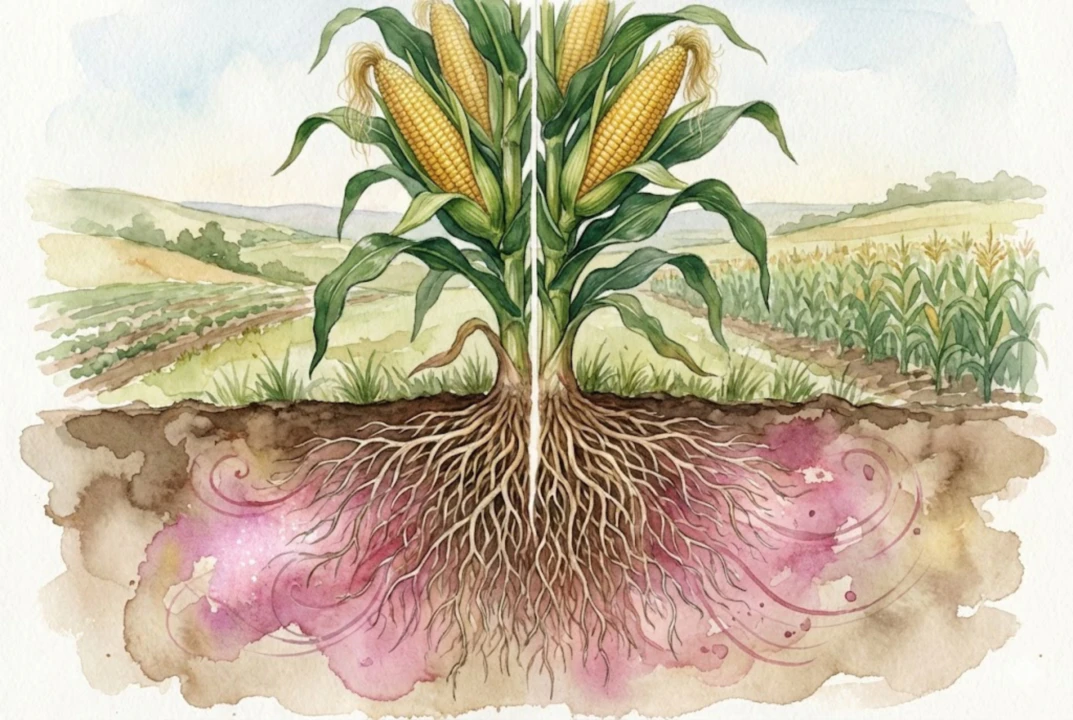
- Root Mass: Visual difference in root hairs (the mop head effect).
- Stress Mitigation: How the product helped during dry spells via ACC Deaminase.
- ROI: Low cost ($6/ac) + High yield ($38/ac) = Positive return.
- Application: Easy planter box integration with DUST lubricant.
Kevin Kalb, a 15-time national yield winner, tested over 30 biological products in five years and found exactly zero that worked.
He was ready to write off the entire ‘snake oil’ category forever.
But in 2025, one final ‘hail mary’ trial with a specific pink pigment bacteria didn’t just change his mind—it propelled him to a massive 425 bushel-per-acre win in the NCGA non-irrigated corn division.
Why Do Farmers Hate Biologicals?
Summary
Because consistency is rare, and ‘invisible’ results are hard to trust.
For decades, the agricultural biologicals market has been the ‘Wild West.’
Farmers are bombarded with ‘bugs in a jug’ that promise the moon but deliver nothing.
The skepticism is well-founded.
The Survivability Problem
Most beneficial bacteria die in the jug, in the sprayer, or on the leaf surface before they ever help the plant.
UV radiation and desiccation are brutal killers.
The Invisible Benefit
Unlike a herbicide that visibly kills weeds in 3 days, a biostimulant might add 5% yield that is masked by field variability.
Without a weigh wagon, you’d never know.
Kevin Kalb’s Experience
‘I told them I’m done with biologicals,’ Kalb admitted.
After 30 failures, his ‘trust account’ with the industry was overdrawn.
The Turning Point: One Last Trial
Summary
A single 2025 trial on high-yield contest acres proved the difference.
NewLeaf Symbiotics convinced Kalb to try their product, Terrasym, on his most valuable ground.
This wasn’t a back-40 experiment; it was on his contest plots.
The Visual ‘Aha’
Long before harvest, Kalb saw the difference.
Digging up roots (a practice he swears by), he found ‘mop head’ root systems on the treated corn that dwarfed the untreated checks.
The Result
The treated plot hit 425 bushels per acre in a non-irrigated field.
The Redemption
This wasn’t just a win; it was a validation.
The biologicals didn’t just add potential; they helped the plant capture the massive fertility he was already applying.
What is the ‘Redemption’ Product? (The Science of PPFMs)
Summary
It’s not just ‘bugs’; it’s Methylobacterium, a specific class of bacteria that eats the plant’s metabolic waste.
Terrasym is based on Pink Pigmented Facultative Methylotrophs (PPFMs).
These aren’t generic soil bacteria; they are ‘M-trophs’ that live on the plant’s surface.
How it Works (The Methanol Loop)

Plant Grows
As corn grows, cell wall expansion releases methanol as a waste gas.
Bacteria Feeds
PPFMs colonize the leaf and root surface, consuming this methanol (which can be toxic to the plant in high concentrations).
Positive Feedback
In exchange, the bacteria secrete auxins (IAA) and cytokinins, triggering rapid root development and stress tolerance.
Data Comparison: Generic vs. PPFM
| Feature | Generic Biologicals | PPFMs (Terrasym) |
|---|---|---|
| Survival | Weak (dies in UV) | High (Pink pigment blocks UV) |
| Food Source | Soil Organic Matter | Methanol (from the plant itself) |
| Consistency | Variable | High (Win rate >75%) |
How Did It Deliver 425 Bushels?
Summary
By maximizing ‘Nutrient Use Efficiency’ (NUE) and mitigating stress.
In high-yield environments (300+ bu/A), nutrients are rarely the limiting factor—uptake is.
You can dump 400 lbs of Nitrogen, but if the roots can’t drink it, it’s wasted.
Root Mass
The auxin boost created a larger root surface area, acting like a bigger straw to suck up the fertility Kalb applied.
Stress Buffer
The 2025 season had dry spells.
The PPFMs produced ACC Deaminase, an enzyme that lowers ethylene (the ‘panic’ hormone).
While neighbors’ corn rolled up, Kalb’s stayed open and photosynthesizing.
Stay Green
The treated corn held its green integrity longer into the fall, adding crucial days to the grain fill period.
Application & Integration
Summary
It’s easy—either in the furrow or in the box.
For a ‘systems approach’ farmer like Kalb, products must be easy to use.
Terrasym won here too.
Option A: Planter Box (The ‘DUST’ Method)

NewLeaf partnered with Low Mμ Tech to create a 2-in-1 product.
- What it is: The biological is mixed into a soy-protein lubricant (DUST) that replaces graphite/talc.
- Benefit: No extra passes. You lubricate your planter and treat your seed simultaneously.
- Rate: ~0.5 oz per unit (80k seeds).
Option B: In-Furrow

- Rate: 1 lb per 10-15 gallons of water.
- Compatibility: Can be mixed with many starters, but never with strong biocides or chlorine. Kalb used this method for maximum consistency.
Does It Pay? (The ROI)
Summary
At ~$6.00/acre, the break-even is virtually guaranteed.
- Cost: ~$6.00 per acre.
- Break-Even: ~1.5 bushels of corn.
- Kalb’s Gain: The contest plot gained significantly more than 1.5 bushels.
- Average Data: Across 200+ trials, the average gain is +8.5 bu/A.
- The Math: 8.5 bu * $4.50 = $38.25 revenue – $6.00 cost = $32.25 net profit/acre.

Leave a Reply