
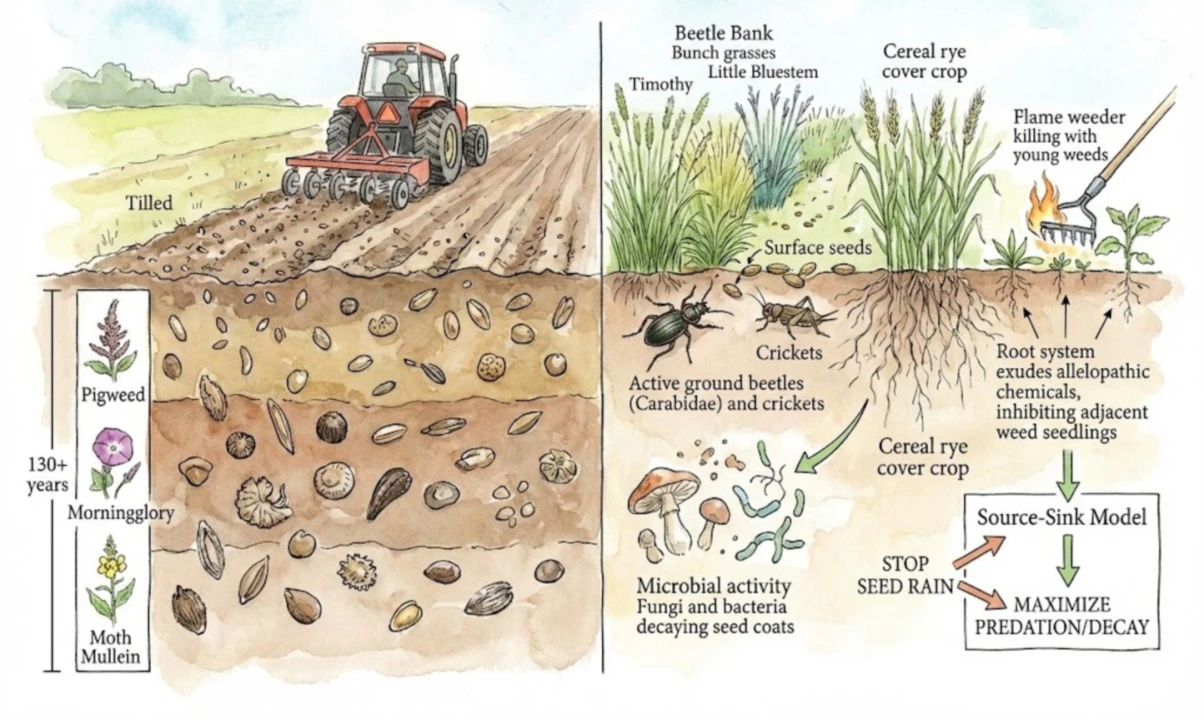
Summary
- The weed seed bank is the primary source of future weed infestations, but 95% of it can be depleted naturally within 5 years by stopping new seed inputs.
- Promoting beneficial insects like ground beetles through habitat creation (beetle banks) can result in the predation of up to 90% of surface weed seeds.
- Integrating biological strategies like allelopathic cover crops, stale seedbeds, and harvest weed seed control creates a resilient system that outcompetes bacteria and fungi.
Key Points
- The Source-Sink Model: Explain treating the seed bank as a financial account—stop deposits (seeds) and maximize withdrawals (predation/decay).
- The Tillage Trap: Why deep tillage buries seeds in a state of dormancy, preserving them for decades, while no-till exposes them to destruction.
- Insect Allies: The critical role of Granivores (e.g., Carabid beetles) and how to build Beetle Banks to support them.
- Chemical Warfare (Allelopathy): Using Cereal Rye’s root exudates to inhibit weed germination naturally.
- Stale Seedbed Technique: The specific timing (20-30 days pre-plant) to flush out and kill the surface layer of weeds.
- Microbial Decay: How healthy soil with high organic matter accelerates the rotting of weed seed coats.
- Harvest Control: Using mechanical destructors or chaff lining to prevent late-season weeds from replenishing the bank.
Stop pulling weeds. Seriously. If you are on your knees pulling individual weeds, you are losing the war. You are fighting the symptom (the plant), not the disease (the seed bank).
The Weed Seed Bank is the reserve of millions of dormant seeds hiding in your soil, waiting for a flash of light to explode into life.
Some of these seeds, like Moth Mullein, can survive for 130 years.
But here is the good news: if you stop adding new seeds, 95% of that bank will die naturally within 5 years.
What exactly is the Weed Seed Bank?
It is the soil’s memory of past mistakes. Every weed that went to seed 5 years ago deposited a withdrawal that you are dealing with today.
The seed bank works on a simple Source-Sink model:
- Source: New seeds falling from mature weeds.
- Sink: Seeds dying from predation (eaten), decay (rotted), or fatal germination.
To win, you simply need to close the Source (zero tolerance for seed rain) and maximize the Sink.
How long do these seeds actually survive?

It depends on the species, but safe burial is the enemy.
Annual grasses (like foxtail) are short-lived, often rotting within 2-3 years.
However, broadleaf weeds with hard seed coats (like Pigweed and Morningglory) are built for time travel.
The famous Beal Experiment at Michigan State University proved that Verbascum blattaria seeds could germinate after being buried for 130 years.
Data Comparison: Seed Longevity
| Weed Type | Typical Persistence | Strategy |
|---|---|---|
| Grasses (Foxtail) | 1-3 Years | Wait them out (short rotation) |
| Broadleaves (Pigweed) | 5-40 Years | Zero tolerance (must be killed) |
| Moth Mullein | 100+ Years | Do not till deep! |
How can insects help me?
Harness the power of Granivores (seed eaters).
Nature has a cleanup crew—Ground Beetles (Carabids), Crickets, and Ants—that can consume 65-90% of the weed seeds on the soil surface before they ever sprout.
Which insects are the best predators?

Ground Beetles (Carabidae) are the heavyweights. A single beetle can eat hundreds of seeds a night.
They are nocturnal hunters that use chemical cues to find the lipid-rich seeds of weeds like Lambsquarters and Amaranth.
How do I get more of them?

You need to build them a house aka a Beetle Bank.
Carabids cannot fly; they walk. In a large bare field, they can’t reach the middle. A Beetle Bank is a raised strip (2 meters wide) of native bunch grasses planted right through your garden or field.
The dense crowns of grasses like Timothy or Little Bluestem provide the dry, warm winter shelter they need to survive freezing temperatures.
Can cover crops kill weed seeds?
Yes, using Allelopathy. Some plants engage in chemical warfare, releasing compounds from their roots that inhibit the germination of their neighbors.
Which cover crop is the most aggressive?

Cereal Rye (Secale cereale) is the gold standard. It releases benzoxazinoids (DIMBOA) that chemically burn the root tips of small-seeded weeds.
To get this effect, you need biomass—aim for a thick stand (5,600 kg/ha). The chemical release peaks when the rye is terminated and begins to decay.
Data Comparison: Allelopathic Power
| Crop | Chemical Agent | Target Weeds |
|---|---|---|
| Cereal Rye | Benzoxazinoids | Pigweed, Lambsquarters |
| Sorghum-Sudan | Sorgoleone | Crabgrass, Bermuda |
| Mustard | Isothiocyanates | Soil Fungi, Nematodes |
Recommended Products
Red Dragon VT 2-23 C Weed Dragon
https://www.amazon.com/dp/B00004Z2FP
- Why it helps: Perfect for the stale seedbed technique. It allows you to kill the flush of weeds without disturbing the soil (which would bring up new seeds).
- How to use it: Pass the flame over tiny weeds (1 inch tall). You do not need to burn them to ash; just heat them enough to burst their cells (1/10th of a second).
Does Tillage help or hurt?
Tillage is usually a trap. While it kills the weed you see, it plants the next generation.
Why is no-till better for seed banks?

Deep burial induces dormancy. Seeds buried 4 inches deep sense the lack of light and go to sleep, preserving their energy for decades. Seeds left on the surface in a no-till system are exposed to:
- Predators: Beetles can find them.
- Weather: Freeze-thaw cycles crack their coats.
- Bait: They are tempted to sprout in small rains, then die when it dries out.
When should I use the ‘Stale Seedbed’ technique?

This is the one time you should till—shallowly.
About 20-30 days before planting your crop, till the top 2 inches of soil. This flashes the seeds with light (the wake-up signal).
Wait 2 weeks for the flush of weeds to turn the soil green. Then, kill them with a flame weeder or very shallow hoeing.
DO NOT till again, or you will bring up a fresh batch.
The Result
You deplete the germination zone (the top 2 inches) and plant into a stale (clean) bed.
Can soil microbes rot the seeds?
Yes. A healthy soil eats seeds.
Fungi and bacteria produce enzymes like chitinase and protease that dissolve the hard seed coats protecting the embryo.
Research has shown that in biologically active soils, 99% of Velvetleaf seeds can decay in just 3 months.
How do I boost this microbial decay?

Feed the microbes.
- Add Organic Matter: Compost and cover crop residue fuel microbial blooms.
- Avoid Fungicides: Broad-spectrum fungicides kill the very organisms trying to help you.
- Seed-Soil Contact: Ensure seeds are pressed into the soil (via a roller or rain) so microbes can colonize the coat.
Practical Applications: The 5-Year Plan
Year 1: Stop the Bleeding

- Switch to No-Till.
- Install beetle banks in field margins.
- Zero tolerance for seed rain (mow or bag clippings if weeds escape).
Year 2: The Flush

- Use the Stale Seedbed technique before every spring planting.
- Plant thick Cereal Rye cover crops in winter.
Year 3-5: The Collapse

- Maintain habitat.
- You will see a massive drop in weed pressure as the surface bank is exhausted and no new deposits are made.

Leave a Reply