
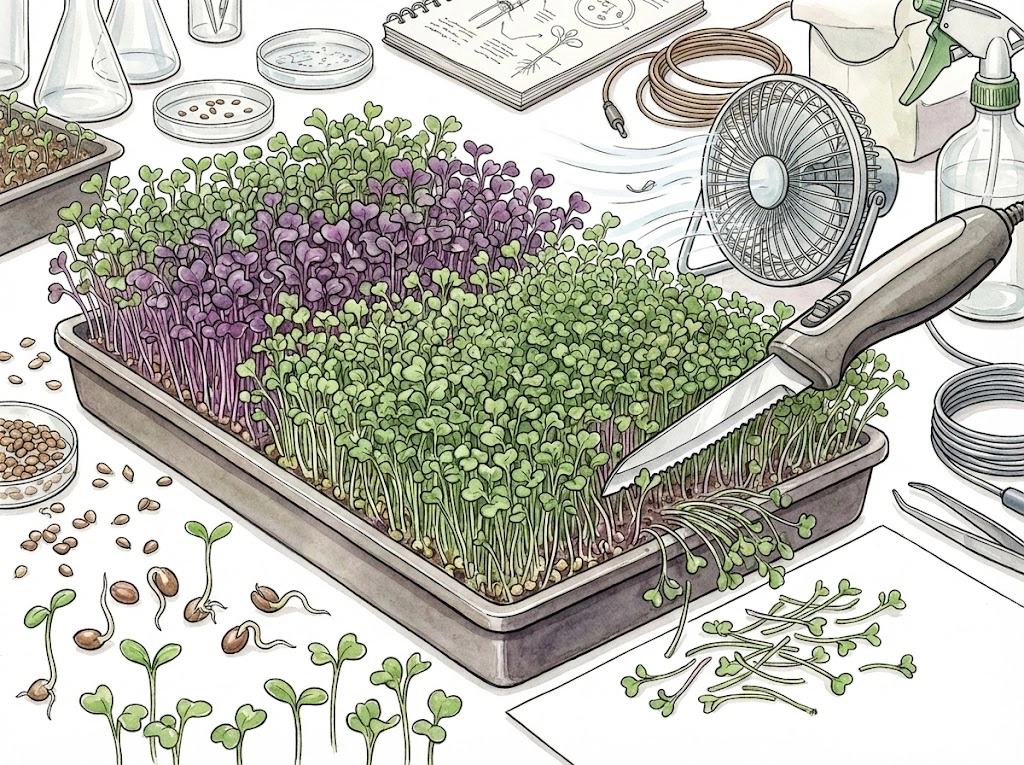
Summary
- High-density planting increases revenue per square foot by maximizing yield and turnover.
- Fast-growing crops like Radish and Broccoli offer the highest annual cycle potential.
- Active airflow and electric harvesting tools are essential for managing dense canopies efficiently.
Key Points
- Density Profitability: Doubling seeding density can nearly double harvest weight.
- Turnover Speed: 10-day crops allow for 36+ cycles per year, boosting cash flow.
- Optimal Crops: Radish, Broccoli, and Kale are best for high-density systems.
- Seeding Rates: Use 40-50g for Radish and 25-30g for Broccoli per 1020 tray.
- Disease Control: Airflow through the canopy is critical to prevent damping off.
- Harvest Efficiency: Electric knives reduce labor time by 50% compared to scissors.
- Sales Strategy: Sell consistency to chefs using bulk packaging; use clamshells for retail.
You can increase annual yields by 40% with high density microgreens planting.
This method maximizes revenue per square foot.
It works by optimizing seeding rates and turnover times.
You manage the microclimate to prevent disease.
This guide explains the science.
Why does density matter for profit?
Density increases yield weight and revenue.
Doubling your seeding density nearly doubles harvest weight.
This works until disease or stunting occurs.
CRITICAL
You must find the sweet spot. This maximizes biomass without triggering damping off.
How does turnover speed affect cash flow?

Turnover speed multiplies your revenue.
A 10-day crop allows 36 cycles per year.
A 20-day crop allows only 18.
Fast crops generate more total revenue.
This is true even if they sell for less per pound.
TIP
Prioritize rapid crops like Radish to boost cash flow.
Data Comparison: Cycle Potential
| Crop | Days to Harvest | Cycles/Year | Revenue Potential |
|---|---|---|---|
| Radish | 8-10 | 36-40 | High |
| Broccoli | 10-14 | 26-30 | High |
| Pea Shoots | 10-14 | 26-30 | Medium |
| Basil | 21-28 | 12-15 | Low |
EditCtrl: Disentangled Local and Global Control for Real-Time Generative Video Editing
Which crops comprise the fastest growing microgreens for profit?
Radish and Broccoli are the fastest growing microgreens for profit.
They are ready in as little as 10 days.
These Brassicas germinate rapidly.
They outcompete pathogens.
Their vertical growth makes harvesting easy.
Can I grow sunflower at high density?

Yes, but you must remove hulls vigorously.
Sunflower shoots create a dense canopy.
This traps moisture.
Mold risk increases exponentially.
WARNING
You must provide aggressive airflow. Ideally, assist hull shedding during blackout.
What about basil and cilantro?

No, these crops fail at high density.
They grow too slowly.
They are susceptible to damping off.
Their leaves need lateral space.
Grow these at lower densities for better quality.
What is the optimal seeding density for microgreens?
The optimal seeding density balances yield with airflow.
Stick to proven weight ranges.
This prevents overcrowding.
CAUTION
Overcrowding leads to weak stems and rot.
What are the specific rates for 1020 trays?

Use 40-50 grams for Rambo Radish.
Use 25-30 grams for Broccoli and Kale.
These rates create a thick canopy.
They suppress weeds.
They max out weight without choking plants.
Higher rates cause leggy growth.
Does the medium affect seeding rate?

Yes, reduce rates by 10-15% for hydroponic mats.
Mats exhibit less buffering capacity than soil.
Soil holds more moisture.
It allows for aggressive stocking.
Mats require careful management.
How do I prevent disease in high density crops?
Airflow prevents fungal pathogens.
You must move air through the canopy.
Stagnant air breeds Pythium.
Fans are your primary defense.
What airflow setup do I need?

Install active circulation fans on every level.
Do not rely on a ceiling fan.
Position fans to blow across tray tops.
This disrupts humidity layers.
It encourages transpiration.
This keeps foliage dry.
Is humidity the enemy?

High humidity causes issues during growth.
Aim for 40-60% relative humidity.
Higher levels slow transpiration.
This leads to calcium issues.
Lower levels dry plants out.
Stability prevents stress.
What about biological controls and sanitation?
Sanitation starts before you seed.
Always scrub used trays to remove biofilm.
Soak them in a 10% bleach solution or use food-grade H2O2.
This kills lingering spores.
Biological fungicides like Bacillus subtilis can be applied to the medium.
These beneficial bacteria colonize the root zone.
They outcompete pathogens like Pythium.
Spot treat any mold outbreaks immediately with H2O2 spray.
Remove the affected area to save the rest of the tray.
What is the best harvesting tool?
An electric carving knife beats scissors.
It cuts harvesting time by 50%.
The blades saw through stems cleanly.
They do not pull roots up.
This tool protects your wrists.
Why not use a sharp chef knife?

A chef knife drags the mat.
It dulls quickly on fibrous stems.
An electric knife does the work for you.
It requires zero force.
It ensures a clean cut every time.
How do I wash and store greens?

Wash greens in cold water immediately.
Spin them dry.
Store in airtight containers.
Keep them at 35-40 degrees F.
Proper cooling extends freshness.
CRITICAL
Moisture ruins shelf life.
How do I maximize urban farm baby leaf crop turnover sales?
Selling high volume requires consistent buyers.
Chefs need steady supplies.
Farmers markets are unpredictable.
Indoor farming provides reliability.
Utilize this advantage.
Should I package in bags or clamshells?

Use clamshells for retail.
They look premium.
Consumers prefer them.
Use bulk bags for restaurants.
They reduce waste.
They store easily.
Clear packaging shows freshness.
How do I price for profit?

Charge $25-$40 per pound.
Calculate your cost per tray.
Aim for a 50% margin.
High density lowers cost per ounce.

Leave a Reply