
Summary
- Genetics Meets Environment: Purple Magic is a high-performance F1 hybrid that requires full solar exposure and cool nights to trigger the production of anthocyanins, the antioxidants responsible for its vibrant purple color.
- Precision Nutrition: Achieving large, dense heads requires a strategic nutrient shift from Nitrogen (for leaf canopy) to Calcium and Boron (for structural integrity), supplemented by bio-stimulants like seaweed extract.
- Preservation is Key: The unique purple pigment is water-soluble and heat-sensitive; boiling this variety destroys the color, while steaming or roasting with a splash of acid preserves both the hue and the nutritional value.
Key Takeaways
- The Sunscreen Effect: The purple color is actually a plant stress response to UV light and cold; without intense light and cool temperatures, the plant will revert to green.
- The Boron Non-Negotiable: This variety is susceptible to hollow heart if Boron is lacking; a targeted foliar spray at the heading stage is the secret to solid, heavy stems.
- Don’t Drown the Magic: Never boil Purple Magic. The color will leach into the water immediately. Steam or roast it to keep it purple.
Introduction: The Appeal of Purple Magic
Let’s be honest. You likely didn’t choose this guide because you want to grow the standard green broccoli found in supermarkets.
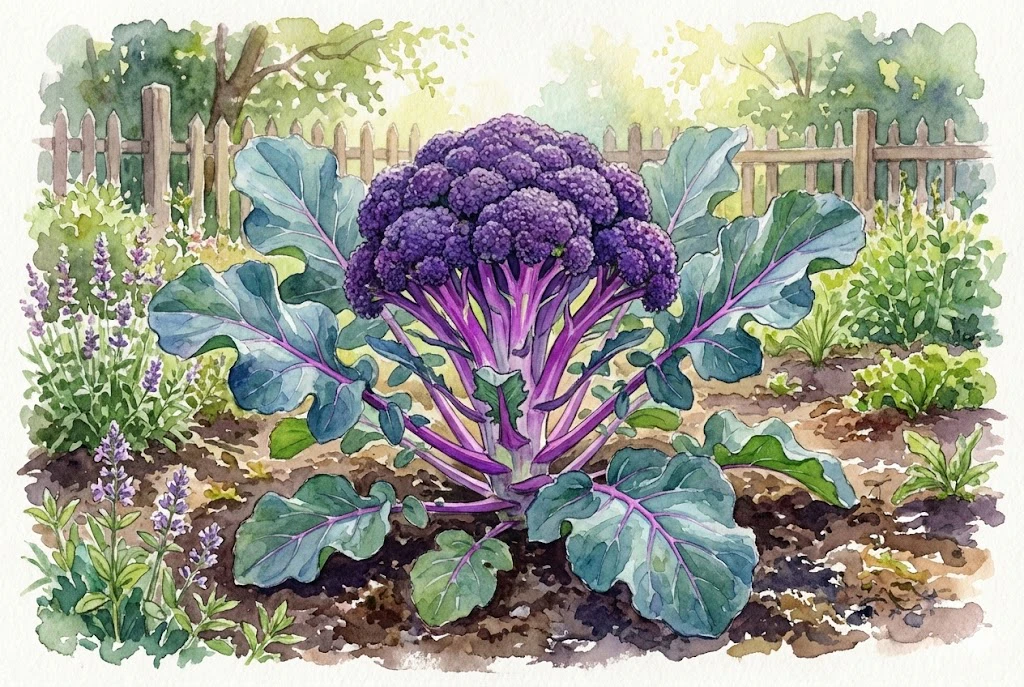
You are here because you saw Purple Magic—with its vibrant purple stem and deep violet dome—and decided you wanted to grow it.
That is an excellent choice.
However, it is important to understand that growing high-performance F1 hybrids like Purple Magic differs from growing simpler crops like radishes.
You cannot simply plant the seeds and expect a perfect result without effort.
This plant is genetically designed to produce high levels of anthocyanins (the same antioxidants found in blueberries), and it requires specific conditions to achieve this.
The Science of the Purple: Understanding Pigmentation
To grow this variety successfully, it helps to understand the plant’s biology.
The color in Purple Magic comes from a class of flavonoids called anthocyanins.
These are water-soluble pigments that can appear red, purple, or blue depending on pH.
In this broccoli, the color is primarily due to specific delphinidin compounds.
The Role of Stress

Gardeners often view stress as a negative factor to be avoided.
However, for purple brassicas, a controlled amount of stress triggers the color intensity you want.
Anthocyanins serve a protective function: they act as a shield against radiation and help the plant withstand cold.
When the plant detects high ultraviolet (UV) radiation or dropping temperatures, it produces these pigments to protect its cells.
Effects of nutrient solution temperature on the concentration of major bioactive compounds in red perilla
Light and Temperature Requirements

Anthocyanin production relies on light.
The plant uses UV radiation as a signal to increase pigment production for protection.
Consequently, Purple Magic requires full sun exposure; shade will reduce color intensity.
Furthermore, the deepest purple develops when the plant experiences cool nights.
Cold conditions trigger the accumulation of sugars and anthocyanins, which protect the plant from freezing while enhancing flavor and color.
Addressing Soil pH Misconceptions

It is important to address a common misconception.
Gardeners often ask if changing soil pH will alter the broccoli’s color, similar to how it affects Hydrangeas.
The answer is no.
While Hydrangea macrophylla changes color based on soil pH and aluminum availability, the purple in Purple Magic is a genetic trait.
You cannot change the color of this broccoli by altering soil acidity.
The Foundation: Soil Chemistry and Preparation
You cannot correct poor soil conditions with foliar sprays alone. Purple Magic is a heavy feeder, meaning it depletes soil nutrients rapidly. If your soil quality is poor, your yield will suffer.
The Ideal pH Range

Broccoli thrives in a pH range of 6.0 to 7.0.
This range ensures that essential nutrients remain chemically soluble and available to the plant.
Below 6.0, Magnesium deficiency becomes a risk; above 7.5, the plant may struggle to absorb Boron and Manganese.
Soil Texture and Stability

Purple Magic grows upright and produces a heavy head, which requires physical stability.
Loose sandy soil may not support the weight, causing the plant to tip, while heavy clay can suffocate the roots.
The ideal soil is a friable loam rich in organic matter, which retains moisture effectively and holds nutrients well.
The Growth Cycle: A Timeline

Growing Purple Magic is a time-sensitive process.
From transplanting, you have roughly 90 days until harvest.
This timeline is divided into three phases, each requiring a different nutritional approach.
Phase 1: Vegetative Growth (Days 1–45)
The Objective
Maximize Leaf Area.
The rule for brassicas is simple: the size of the head depends on the size of the plant’s leaves before heading begins.
The leaves generate the energy required to support the broccoli head. During the first 45 days, your goal is to grow large, healthy leaves using Nitrogen.
Nutritional and Visual Diagnosis in Broccoli (Brassica oleracea var. italica L.) Plants: Disorders in Physiological Activity, Nutritional Efficiency and Metabolism of Carbohydrates
Phase 2: The Transition (Days 46–60)
The Objective
Structural Integrity and Head Initiation.
The plant changes its focus from leaf growth to reproduction.
It needs strong cell walls to support the rapid expansion of the head.
Reduce Nitrogen input at this stage; excessive Nitrogen now can lead to hollow stems and soft heads.
Instead, focus on Calcium and Boron to strengthen the plant’s cellular structure.
Disorders of Cole Crops
Phase 3: The Heading Stage (Days 61–90)
The Objective
Density, Color, and Flavor.
The purple head is now developing.
Inconsistent watering during this phase causes buds to separate, resulting in a ricey texture and bitter flavor.
The plant requires consistent moisture to expand the head properly.
Advanced Nutrition

To achieve optimal yields, we use a targeted strategy involving biostimulants and micronutrients.
Key Inputs: Seaweed, Amino Acids, and Boron
Research on brassica production highlights three inputs that improve results: Seaweed Extract, Amino Acids, and Boron.
1. Seaweed & Amino Acids
Foliar application of seaweed extract has been shown to increase head weight and improve tolerance to stress.
When combined with amino acids (such as fish hydrolysate), the plant conserves metabolic energy, which can then be directed toward growth.
Effect of foliar application of bio-stimulants on growth, yield and nutritional quality of broccoli
2. Boron (The Essential Micronutrient)
Broccoli has a high requirement for Boron.
This nutrient regulates the transport of sugars and maintains cell wall integrity.
Without adequate Boron, the plant may develop Hollow Heart (hollow, brown stems) and deformed heads.
The Purple Magic Feeding Schedule
| Growth Stage | Day (Approx) | Action | Product/Recipe (See DIY Section) |
|---|---|---|---|
| Transplant | Day 0 | Soil Drench | Mix compost into hole + Recipe A (Calcium/Boron Base). |
| Vegetative | Day 14 | Side Dress | Apply nitrogen-rich fertilizer (Blood meal or Fish Meal) around base. |
| Vegetative | Day 30 | Foliar Spray | Recipe B (Stress Management) – Amino Acids + Seaweed. |
| Transition | Day 45 | Foliar Spray | Recipe C (Head Development) – Boron + Calcium. Critical Step! |
| Heading | Day 60 | Side Dress | Apply balanced fertilizer (low nitrogen, high potassium). |
| Heading | Day 70 | Foliar Spray | Recipe B (Stress Management) – Repeat to boost head density. |
DIY Nutrient Solutions

You can create effective biostimulants using common ingredients.
Recipe A: Calcium Booster
The Chemistry
Eggshells are primarily Calcium Carbonate.
Reacting them with White Vinegar (Acetic Acid) creates Calcium Acetate, a water-soluble form of calcium that plants can absorb immediately.
Ingredients
20 dry eggshells, White Vinegar.
The Protocol
Grind shells to powder.
Pour vinegar over shells (1 part powder to 10 parts vinegar).
Allow the mixture to react and sit for 24-48 hours.
Strain.
Application
Mix 4 tablespoons of Concentrate per 1 gallon of water.
Recipe B: Stress Management (Amino-Kelp Blend)
The Logic
This mixture combines the benefits of kelp with the nutrients found in fish protein.
Ingredients
Liquid Fish Fertilizer (Hydrolysate), Liquid Kelp.
The Protocol
Mix 1 tablespoon of Fish Fertilizer and 1 tablespoon of Liquid Kelp into 1 gallon of water.
Application
Spray leaves until wet, preferably in the early morning or late evening.
Recipe C: Head Development (Boron Solution)
The Warning
Precision is critical.
Boron toxicity can damage plants if over-applied.
Ingredients
Household Borax (Sodium Tetraborate).
The Protocol
Dissolve 1 level teaspoon of Borax into 1 gallon of warm water.
Application
Spray foliage lightly only once or twice per season.
Diagnostics: Troubleshooting Guide

Premature Heading (Buttoning)
Symptom
The plant is small but forming a tiny head.
Diagnosis
This is a stress response (often due to cold or nutrient deficiency).
The plant attempts to reproduce prematurely due to unfavorable conditions.
The Fix: Remove the head immediately. Feed heavily with Recipe B to stimulate side shoot growth.
Ricey Head
Symptom
The purple dome looks fuzzy or velvety; buds are separating.
Diagnosis
This is caused by heat stress or the plant being over-mature.
The Fix: Harvest immediately. Once buds open into yellow flowers, the flavor becomes bitter.
Yellowing Leaves
Symptom
Lower leaves turn yellow and drop.
Diagnosis
Nitrogen Deficiency.
The plant is translocating Nitrogen from older leaves to support the new head.
The Fix
Apply Nitrogen immediately.
Watch Out for These Nutrient Deficiency Symptoms | Home and Garden Education Center
Harvest and Post-Harvest

Harvesting Technique
Once the head is a deep purple dome (around 90 days), use a sharp knife to cut the main stem at a 45-degree angle, roughly 5-6 inches below the head.
This angle prevents water from pooling on the cut stem and causing rot.
Secondary Growth
After the main harvest, continue watering.
Purple Magic often produces smaller side shoots from the leaf nodes.
These are often sweeter than the main head.
Cooking Advice
Anthocyanins are water-soluble.
Boiling Purple Magic will cause the pigment to leach out, resulting in green broccoli.
The Fix
Steam, roast, or eat raw.
The Trick
Adding lemon juice to cooked broccoli stabilizes the anthocyanins, helping to retain the bright color.
Antioxidant properties of green broccoli and purple-sprouting broccoli under different cooking conditions
Increasing Production: Indoors & Containers

The 5-Gallon Bucket Method
Broccoli has a large root system.
If growing in containers, use a 5-gallon bucket with drainage holes and a high-quality potting mix amended with compost.
Indoors, use high-intensity grow lights (LEDs) running 14-16 hours a day, placed 12-18 inches above the plants, to prevent weak stems.
Spacing for Yield
If growing outdoors, spacing significantly affects head size.
While it may be tempting to plant closely, 12-inch spacing results in smaller heads.
For maximum size, plant 18-24 inches apart to allow roots sufficient space to access nutrients.
Conclusion
Growing Purple Magic requires precision.
It offers a significant reward in terms of nutrition and flavor, but it demands proper care.
Your Purple Magic Summary:
- Sun & Cool: Ensure full sun for growth and cool nights for color development.
- Feed the Soil: Start with compost. Apply Nitrogen early, then switch to Calcium and Potassium later.
- Micronutrients: Use Boron and Seaweed solutions to maximize potential.
- Cooking: Steam or roast to preserve the purple color; do not boil.
You now possess the necessary knowledge and practical skills to succeed.
It is time to prepare your nutrients and start growing.

Leave a Reply