
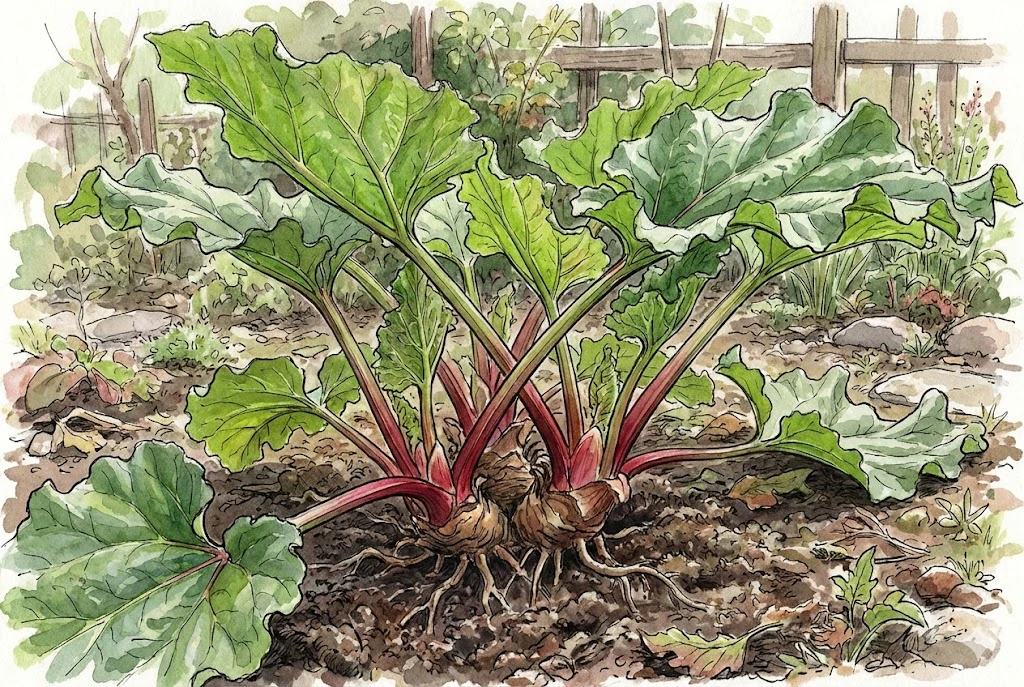
Summary
Rhubarb is a cold-addicted, heavy-feeding perennial that demands a winter freeze to reset its internal clock and a nutrient-rich, well-drained soil to fuel its explosive spring growth.
Success relies on patience—ignoring the first year’s harvest to charge the root battery—and mastering the twist and pull harvest technique to prevent crown rot.
You can even practice the dark arts of forcing to produce tender, champagne-pink stalks in the dead of winter by excluding all light from the crown.
Key Takeaways
- Respect the Chill: Rhubarb needs roughly 500 hours of temperatures between 28°F and 40°F to break dormancy; without this winter nap, it wakes up weak, spindly, and prone to bolting.
- The Manure Mandate: This plant is a glutton for organic matter; you must amend your soil heavily with composted manure to retain moisture and fuel those giant leaves, which act as solar panels for the root system.
- Twist, Don’t Cut: Never take a knife to the crown; harvest by grasping the stalk near the base and twisting while pulling upwards to ensure it pops out cleanly, preventing rot from entering the root system.
- The “Stop Sign” Rule: Do not harvest in year one, go light in year two, and stop picking by July in subsequent years to let the plant recharge its energy reserves for the next season.
- Toxic but Compostable: While the leaves contain toxic oxalic acid and should never be eaten (the LD50 is high, but they will still make you sick), they are perfectly safe to toss in your compost pile as the toxins break down during decomposition.
Introduction: Understanding Rhubarb
Rhubarb belongs to the buckwheat family (Polygonaceae), related to sorrel and knotweed.
This relationship helps explain its behavior.
Like its relatives, it is persistent and has a deep, fleshy rhizome (underground stem) that acts as an energy store.
It accumulates carbohydrates throughout the summer and autumn to fuel rapid growth in the spring. This energy reserve is the central part of the plant.
Every decision you make—from how much organic matter to apply to when you stop harvesting—is fundamentally about managing the energy levels of that root system.
Historically, rhubarb was not eaten.
For thousands of years, dating back to 2700 B.C. in China, it was used for its medicinal properties.
The culinary potential of the stalks was only recognized in the 18th century, when sugar became more affordable, making the tart flavor palatable.
Today, we grow cultivars selected for lower fiber, higher sugar, and better color, but the plant retains the hardiness of its ancestors.
Physiology – Understanding the Need for Cold
To care for rhubarb effectively, it is important to understand the plant’s internal biological rhythm.
Its growth cycle is dictated by temperature, specifically the accumulation of cold weather.

The Chill Factor: Understanding Dormancy
Rhubarb requires cold temperatures to grow properly.
This is known as the chilling requirement.
To break dormancy and ensure vigorous growth in spring, rhubarb crowns typically need at least 500 hours where the temperature is between 28°F and 40°F (-2°C to 4°C).
This matters because without this winter rest period, the plant emerges weakly.
In warmer climates (USDA Zones 8 and above), rhubarb that hasn’t experienced enough cold will produce thin stalks and may flower (bolt) immediately in an attempt to reproduce before dying.
This is a stress response; the plant perceives the lack of winter as a problem and tries to produce seeds.
In its ideal range (Zones 3-6), the freezing winter temperatures trigger a reset within the crown.
Starches are converted to sugars to protect the cells from freezing.
When the soil warms above 40°F in spring, the plant releases this stored energy, allowing it to grow rapidly, often emerging while snow is still on the ground.
Chilling-Hour Requirements of Fruit Crops | Mississippi State University Extension Service

The Heat Limit: Slowed Summer Growth
Although rhubarb needs the cold, it does not handle heat well.
The ideal average summer temperature for growth is roughly 75°F (24°C).
When temperatures consistently rise above 75°F to 85°F, and especially over 90°F, the plant’s growth slows down significantly.
It enters a state of semi-dormancy often called the summer slump.
This is important for growers in transitional zones (like Tennessee or the mid-Atlantic).
In these regions, a wilted rhubarb plant in July is often not just thirsty—it is shutting down to survive the heat.
Instead of forcing growth with high-nitrogen fertilizer, which can damage the roots and encourage weak growth, the best response is to provide shade and water to keep the plant cool.

Photosynthesis and Energy Storage
The large leaves of the rhubarb plant are essential for photosynthesis.
They have a large surface area to convert sunlight into sugars, which are then moved down the stalk to be stored in the crown.
This relationship is direct: the size and health of the leaves this year determines the size of the harvest next year.
As a result, every leaf you remove—whether for harvest or because it looks damaged—reduces the plant’s ability to recharge its energy reserves.
Soil Preparation Guide
The key to growing large, healthy rhubarb is not a specific product, but rather soil structure.
Rhubarb requires a lot of nutrients and thrives in soil that is rich in organic matter, loamy, and holds moisture well.

Managing Soil pH
While rhubarb can survive in acidic soils (down to pH 5.0), it grows best in a pH range between 6.0 and 6.8.
Nutrient Availability
At this slightly acidic-to-neutral range (6.0-6.8), essential nutrients (Nitrogen, Phosphorus, Potassium) are most available to the roots.
If the pH drops below 5.0, nutrients like phosphorus—crucial for root growth—can become chemically locked in the soil.
In this state, adding fertilizer may not help because the plant cannot absorb it.
Applying Lime
If a soil test shows a pH below 6.0, apply agricultural lime.
A standard recommendation is 5 to 8 pounds of lime per 100 square feet, mixed into the soil before planting.
Since lime takes time to work, applying it a season ahead is the most effective approach.

Soil Texture: Improving Drainage
Rhubarb roots are susceptible to Phytophthora crown rot, which thrives in wet conditions without oxygen.
Therefore, good drainage is essential for the plant’s survival.
Scenario A: Clay Soil
Clay soil holds nutrients well but can suffocate rhubarb roots.
In wet winters, clay can become waterlogged, causing the roots to rot.
Common Mistake
Do not simply add sand to clay. Mixing sand into clay can create a mixture that is too hard and compact.
The Recommended Mix (Clay Amendment)
You must amend the entire planting area to improve airflow and drainage.
Ingredients
1 part Native Clay Soil + 1 part Coarse Organic Material (Compost/Aged Manure) + 1/2 part Peat Moss or Coir.
Method
Dig the planting hole wide—at least 24 inches—to prevent creating a localized water pocket in the loose soil surrounded by hard clay.
Raised Beds
The best solution for heavy clay is to raise the planting area.
A bed 10-12 inches high keeps the crown above the water saturation level, using gravity to help with drainage.
Scenario B: Sandy Soil
Sandy soil drains too quickly and loses nutrients.
Rhubarb grown in sand often struggles with moisture and nutrition, leading to thin stalks.
The Strategy
You need organic matter to act as a sponge, increasing the soil’s ability to hold nutrients and water.
The Recommended Mix (Sandy Soil Amendment)
Ingredients
50% Native Sand + 50% Well-Rotted Manure or Compost.
Method
Dig a deep trench or pit (24 inches wide and deep).
Backfill with this 50/50 mix.
The organic matter helps the sand retain moisture, preventing the drought stress that causes early flowering.
Grow your own rhubarb

The Importance of Organic Matter
University extension guides consistently emphasize the need for organic matter.
Rhubarb responds best to medium-textured soils that are rich in organic content.
How it Works
Organic matter performs three functions: it holds water, it loosens heavy soil for roots, and as it breaks down, it releases a steady supply of nutrients.
Traditional Technique
Ideally, plant rhubarb on top of a layer of manure (buried deep enough not to burn the roots) or incorporate significant amounts of manure before planting.
For home gardens, working a 2-3 inch layer of composted manure into the soil annually is effective.
Planting Protocols

Planting is a long-term commitment to a specific location in your garden.
Take your time with this step. Since a rhubarb patch can last 10 to 20 years, it should be planted with care.
Timing: When to Plant
Rhubarb is a cool-season crop.
The best time to plant is early spring, as soon as the soil can be worked and before the plants start growing.
This allows the roots to establish while the soil is cool and moist.
In milder climates, late fall planting is possible once the plants are dormant, but spring is generally safer to prevent frost heaving.
Sourcing: Seeds vs. Crowns
Seeds
Growing from seed is generally not recommended for those seeking specific results.
Rhubarb cultivars do not grow true to type from seed, meaning the offspring may vary significantly from the parent.
A seedling might be green instead of red or fibrous instead of tender.
Also, seed-grown plants take an extra year to reach maturity.
Crowns/Divisions
This is the standard method.
By using crowns, you are cloning a known variety.
Buy one-year-old crowns from a nursery or get divisions from a healthy established plant.
A viable division must have at least one large eye (bud) and a good portion of root.
Proper Planting Depth
Crown rot is a major cause of failure in new plantings.
The depth of the crown is critical.
The Depth Rule
The eyes (buds) of the crown should be buried no more than 1 to 2 inches below the soil surface.
Finding the Right Balance
- Too Deep: The buds may rot before they can break the surface.
- Too Shallow: The buds may dry out in the wind and sun.
Spacing
Rhubarb plants grow quite large. Space them 3 to 4 feet apart within the row.
Crowding reduces air circulation, which can encourage fungal diseases.
If planting multiple rows, space them 4-5 feet apart to allow room for harvesting.
Fertilization Requirements
Rhubarb is known as a heavy feeder.
It produces a large amount of foliage and stalks in a short time—sometimes doubling in size in a week during spring.
To support this growth, it requires consistent nutrition.

The Nutrient Balance
Nitrogen (N)
Essential for leaf growth. Rhubarb needs plenty of Nitrogen to support its large leaves.
A deficiency leads to slow growth and yellowing of older leaves.
Phosphorus (P)
Critical for root development and energy transfer.
Potassium (K)
Essential for water regulation and disease resistance.
Phosphorus Caution
Continuous use of high-phosphorus fertilizers (like 10-10-10) can lead to phosphorus buildup in the soil. Rhubarb removes relatively little phosphorus compared to Nitrogen and Potassium. If your soil tests high for Phosphorus, switch to a fertilizer with lower Phosphorus content to prevent runoff issues.
Fertilization Schedule
Rhubarb requires nutrients at specific times to match its growth phases.
| Growth Stage | Action | Product/Recipe | Reason |
|---|---|---|---|
| Pre-Planting | Soil Amendment | 1/4 cup 5-10-10 per plant mixed into hole. | Provides initial nutrients for root establishment. |
| Early Spring | Awakening Feed | 1/2 to 1 cup of 10-10-10 per plant OR compost. | Fuels the rapid spring growth; Nitrogen is crucial here. |
| Post-Harvest | Recovery Feed | Sidedress with 2-3 inches of compost or manure + light Nitrogen source. | Replaces nutrients removed during harvest. The plant now switches to storing energy for winter. |
| Late Fall | Dormancy Prep | Mulch with manure/straw (do not cover crown). | Insulates roots and adds organic matter for the next season. |

Organic Fertilizer Options
For those avoiding synthetic chemicals, you can mix organic meals.
These release nutrients slowly, improving the soil health over time.
Mix A: Spring Growth Mix (High Nitrogen)
Use this in March/April to stimulate leaf growth.
- 4 parts Blood Meal (Rapid Nitrogen release)
- 1 part Bone Meal (Phosphorus for roots)
- 1 part Kelp Meal (Potassium and micronutrients)
Application
Sprinkle 1 cup around the base of the plant (avoiding the crown) and water in.
Mix B: Root Strength Mix (Balanced/Fall)
Use this at planting or in late summer to strengthen the roots.
- 2 parts Fish Bone Meal (Balanced nutrients)
- 2 parts Alfalfa Meal (Slow release Nitrogen)
- 1 part Greensand (Potassium)
Application
Mix into the soil at planting or scratch into the surface in autumn.
Liquid Feed for Stressed Plants
If your rhubarb looks stressed from heat or transplanting, a liquid feed works faster than granular fertilizer.
Liquid Seaweed Mix
Mix 1/4 cup Kelp Meal (or liquid seaweed extract) per gallon of water.
Let it steep for 2-3 days if using meal. Apply to the soil or leaves.
The nutrients in seaweed help stimulate root growth and recovery.
Advanced Growing – Forcing
Forcing is the practice of stimulating a plant to grow out of season.
With rhubarb, this produces stalks that are sweeter, more tender, and often pink or champagne-colored because they grow rapidly in the dark.

How Forcing Works
By blocking light, you prevent chlorophyll production, which normally makes stalks green and bitter.
You also force the plant to rely entirely on stored root energy.
Because there is no photosynthesis, the stalks stretch rapidly searching for light, becoming long and tender with smaller leaves.

Outdoor Forcing (The Jar Method)
This is the easiest method for home gardeners as it requires no digging.
Timing
Late winter (January/February), when the plant is dormant but has already experienced cold temperatures.
The Tool
A traditional forcing pot, a tall bucket, or a clean trash can. It must be opaque to block all light.
The Method
- Select: Choose a healthy, mature crown (at least 3 years old).
- Cover: Place the vessel over the dormant crown.
- Insulate: Pack straw or manure around the outside of the vessel to insulate and provide gentle warmth.
- Seal: Cover any holes to ensure total darkness.
- Wait: Check after 4-6 weeks. Harvest when stalks reach the top of the container.
Impact on the Plant
This uses a significant amount of the root’s energy.
Do not harvest from this plant for the rest of the summer. Ideally, allow it to recover for two years before forcing again.

Indoor Forcing
This method produces high-quality stalks but requires digging up the plant.
Step 1: The Chill
Dig up a mature crown in late autumn (November). Leave it on the soil surface exposed to frost so it senses winter.
Step 2: Potting
Once it has frozen a few times (usually by December), bring the crown inside.
Plant it in a pot or box with moist soil or peat moss.
Step 3: The Dark Room
Move the pot to a dark, cool place (50°F-60°F / 10°C-15°C) like a cellar or garage. Total darkness is essential.
Step 4: Harvest
Harvest the stalks after about 4-6 weeks. They will be pale and sweet.
Step 5: Aftercare
These roots are usually exhausted.
Commercial growers often discard them, but a home gardener can replant them in the garden, though they may take years to recover.
↑ This Reddit thread discusses the practical aspects of growing rhubarb indoors and clarifies the difference between forcing in the dark and growing with lights.
Growing in Containers

You can grow rhubarb in a pot, but you must respect its biology.
It is a large plant with a large root system that does not like being constricted.
Container Specifications
Volume
Minimum 10 gallons (approx. 40 liters) per plant. A large planter or whiskey barrel is ideal.
Dimensions
At least 20 inches deep and wide. Shallow pots will cause the roots to circle and overheat.
Material
Avoid unglazed terracotta in hot climates as it dries out too fast.
Plastic, glazed ceramic, or wood retains moisture better. Ensure there are large drainage holes.
Soil Mix for Containers
Garden soil is too heavy for pots and will compact, suffocating the roots.
You need a mix that holds water but drains freely.
Recommended Container Mix
- 2 Parts High-Quality Potting Soil (Base)
- 1 Part Compost (Nutrients and moisture)
- 1 Part Perlite or Pumice (Aeration – crucial for preventing rot)
- Optional: Add a handful of slow-release organic fertilizer.
Special Care for Pots
Watering
Containers dry out much faster than the ground. In summer, you may need to water daily.
Keep the soil consistently moist but never soggy.
Heat Stress
In hot climates, the sun hitting the side of the pot can overheat the roots.
Shade the pot itself or move the container to a spot with afternoon shade.
Winter Protection
Roots in pots are less insulated than in the ground.
If you live in a very cold zone (Zone 4/5), move the pot into an unheated garage or sink the pot into the ground for winter to prevent the root ball from freezing solid.
This video guide demonstrates growing rhubarb in containers, including selecting the right pot size and overwintering steps.
Troubleshooting and Diagnostics
Rhubarb is tough, but it shows signs when it is stressed.
The color of its leaves and the condition of its stalks are key indicators.

Situation: Yellowing and Wilting
Symptom
Leaves turn yellow, wilt, and collapse, often starting at the base.
Diagnosis A (Crown Rot)
If the stalks are mushy at the base and pull away easily, it is likely Phytophthora or bacterial soft rot.
Expert Response
This is usually fatal. Dig out the plant and the surrounding soil immediately. Do not compost this material. Do not plant rhubarb in that spot again for at least 3-4 years and improve drainage before replanting.
Diagnosis B (Verticillium Wilt)
Yellowing typically starts between veins, eventually turning brown.
One side of the plant may wilt while the other looks healthy.
Expert Response
Also incurable. Remove and destroy the plant. Since this fungus lives in the soil, avoid planting other susceptible crops (tomatoes, peppers, strawberries) in that spot.

Situation: Red or Spotted Leaves
Symptom
Red or brown spots on leaves, sometimes becoming holes.
Diagnosis A (Leaf Spot)
Fungal infections are common in wet spring weather. The spots often have a white or gray center.
Expert Response
Remove infected leaves immediately to prevent spread. Ensure good air circulation by weeding and thinning stalks. This usually doesn’t kill the plant. Copper fungicide can be used in severe cases.
Diagnosis B (Red Leaf Disease)
Leaves turn dull red and the crown rots.
Expert Response
This is likely bacterial (Erwinia rhapontici). The leaves turn a dull red, different from the bright red of autumn. Remove the plant. Control insects like aphids, as they may spread the bacteria.

Situation: Premature Flowering (Bolting)
Symptom
A large flower stalk shoots up from the center of the plant.
Diagnosis
The plant is trying to reproduce. This happens due to age, heat, drought, or simply being a mature plant.
The Issue
Studies show that allowing seed stalks to mature reduces the edible yield significantly in subsequent years because the plant diverts energy to seed production.
Expert Response
Remove the flower stalk immediately. Cut it at the base as soon as you see it.

Situation: Pest Damage (Curculio)
Symptom
Notches chewed in stalk edges, sap leaking from holes, and eventual stalk collapse.
Diagnosis
Rhubarb Curculio, a snout beetle about 0.5 inches long, often covered in yellow dust.
Expert Response
Manual Removal
These beetles are large and move slowly. Handpick them and drop them into soapy water.
Weed Control
The curculio lays its eggs in wild dock (Rumex species), a common weed.
To stop the infestation, eliminate wild dock weeds in the area.
Rhubarb Curculio
Harvest Protocols

Harvesting acts as a form of pruning that affects the plant’s future.
It draws upon the energy stored in the roots.
Harvest Schedule
Rhubarb requires patience.
Year 1
STOP. Do not harvest. The plant needs every leaf to generate energy and establish the root system.
Year 2
YIELD. Harvest lightly. Take only a few stalks, and only for 1-2 weeks.
Year 3+
GO. Harvest freely for 8-10 weeks, usually through June/July.
When to Stop Harvesting
You must stop harvesting when:
- It is Early July: In most zones, harvest should end by this time.
- Stalks Become Thin: When new stalks are thin (pencil width), it indicates root reserves are low.
- Summer Heat Arrives: Heat makes stalks woody and fibrous.
The Technique: Twist and Pull
Do not use a knife to harvest from the crown. A knife leaves a cut stub that can decay and invite rot.
The Method
Grasp the stalk near the base. Pull gently outward and down while twisting.
It should separate cleanly from the crown.
This short video demonstrates the correct twist and pull technique to avoid damaging the crown.
The Toxic Leaf Question
Rhubarb leaves contain oxalic acid, which can be toxic to the kidneys.
The Science
The estimated lethal dose for oxalic acid is quite high.
A 145lb (65kg) person would need to eat approximately 11 lbs (5kg) of rhubarb leaves to reach a lethal dose.
The Reality
Do not eat them. They will cause sickness (nausea, abdominal pain) long before they are lethal.
Composting
It is safe to compost rhubarb leaves. The oxalic acid breaks down during decomposition and does not persist in the compost or soil.
Selecting Varieties
Not all rhubarb is the same. Choosing the right cultivar is the first step in successful growing.
Red vs. Green
Many people assume red stalks are sweeter, but this is visual.
Expert tastings often find green varieties (like Victoria) to be more robust and flavorful.
Cultivar List
| Variety | Characteristics | Best Use | Notes |
|---|---|---|---|
| Victoria | Green/Pink, very large. | Jams, chutneys. | The industry standard since 1837. Can flower heavily. |
| Canada Red | Solid red stalks. | Pies. | Sweet, tender, often produces fewer seed stalks. Good for home gardens. |
| Crimson Red | Thick, bright red stalks. | General purpose. | Good balance of sweet/tart. Fits well in the Pacific Northwest. |
| Glaskin’s Perpetual | Green/Red, lower acid. | Late harvesting. | Can often be harvested later in the season without becoming woody. |
| Timperley Early | Early emerging. | Forcing. | Classic choice for winter forcing; starts growing very early. |
| Valentine | Deep red. | Desserts. | Known for being less tart; resistant to flowering. |
| MacDonald | Bright pink/red. | Clay soils. | Resistant to root rot; vigorous and upright. |
Conclusion
Growing rhubarb involves a cycle of growth and rest.
It requires you to manage soil quality, monitor weather conditions, and maintain plant health carefully.
It is an exercise in patience, planting something today that you often cannot eat for two years.
By following the responses outlined here—amending clay with organic matter, respecting the plant’s need for winter dormancy, and diagnosing problems early—you can become a successful grower.
Remember the key rules:
- Feed the soil. Organic mulch is often better than chemical sprays.
- Respect the cold. Let winter do its work; do not rush the spring.
- Twist, don’t cut. Protect the crown.
- Never eat the leaves. (But compost them safely).
Happy gardening.
Report compiled by the Senior Horticultural Extension Specialist.
Data synthesis based on University Extension guidelines and botanical research.

Leave a Reply