
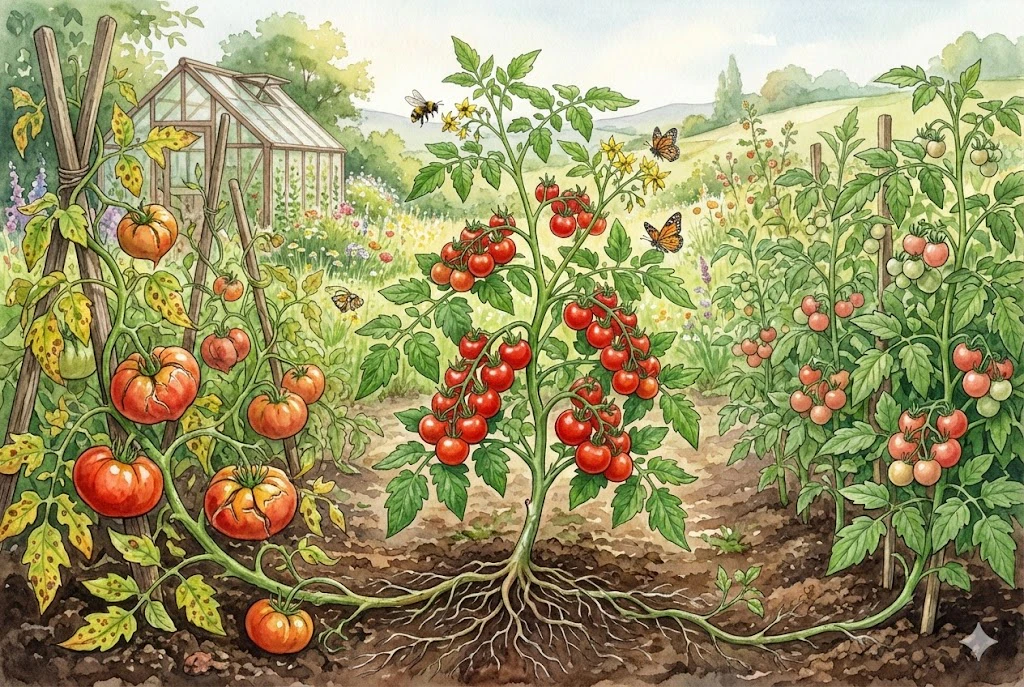
The Tonatico Paradigm in Modern Horticulture
Recognized as a 2025 All-America Selections (AAS) Regional Winner for the Mountain/Southwest and Northeast regions, Tonatico represents a sophisticated genetic achievement by Bejo Seeds, designed to address the specific physiological limitations of traditional cherry tomatoes—most notably, their propensity for epidermal cracking and their vulnerability to soil-borne pathogens.

Genetic Provenance and Classification
To grow Tonatico effectively, one must first understand its genetic background.
It is an F1 hybrid, meaning it is the first filial generation offspring of two distinct, highly inbred parent lines.
This hybridization results in heterosis, or hybrid vigor, which manifests in Tonatico as rapid vegetative growth, uniform fruit set, and enhanced environmental stress resilience compared to open-pollinated varieties.

Morphological Profile
The Tonatico is classified as an indeterminate cherry tomato.
Growth Habit
Unlike determinate (bush) varieties that cease growing after a terminal flower cluster forms, Tonatico retains a vegetative apical meristem.
This means the central vine will continue to grow indefinitely until terminated by frost or mechanical pruning.
Fruit Characteristics
The fruit is a round, bright red cherry tomato, typically 1.25 to 1.5 inches in diameter, weighing between 20 and 25 grams (approximately 1.25 to 2.0 oz).
Sugar Profile
The cultivar is noted for a high Brix level of approximately 8.0, balancing sweetness with the requisite acidity for a robust tomato flavor profile.
The Professional Approach to Cultivation
Professional care focuses on precision rather than just effort. Instead of simply watering or feeding, effective growers adjust moisture and nutrients according to the plant’s specific growth stage.
For Tonatico, this means managing its vigorous indeterminate habit to prevent vegetative overgrowth while supporting its heavy fruit load—up to 200 fruits per plant—through targeted inputs.
Environmental Setup
The cultivation environment determines how well Tonatico performs.
Optimizing this environment is the first step toward high yields.
Tonatico is adaptable, but its yield potential is strictly limited by the weakest link in its environmental chain—usually soil structure or solar exposure.

Soil Physics and Root Zone Preparation
The root system of an indeterminate hybrid like Tonatico is aggressive and extensive.
It requires a soil structure that allows oxygen to reach the roots while retaining enough moisture to support the vine’s water needs.
The Ideal Root Zone
Texture
A sandy loam is the agronomic ideal.
Heavy clays restrict the root expansion of Tonatico, leading to stunted canopy growth.
Pure sands leach nutrients too rapidly for such a heavy feeder.
Drainage Dynamics
While Tonatico possesses genetic resistance to Fusarium Crown and Root Rot (For), this resistance is biological, not physical.
Low oxygen conditions caused by waterlogging will still damage roots, leading to root death regardless of pathogen presence.
Chemical Buffering (pH)
The target pH is 6.0 to 6.8.
- Below 6.0: Macronutrients like Nitrogen (N), Phosphorus (P), and Potassium (K) remain available, but Calcium (Ca) and Magnesium (Mg) availability drops. This is critical because Tonatico is a fast grower, and calcium deficiency at the cellular level can lead to blossom end rot, even if the fruit is genetically crack-resistant.
- Above 7.0: Micronutrients like Iron (Fe) and Manganese (Mn) become locked out, leading to interveinal chlorosis (yellowing between leaf veins), which reduces photosynthetic efficiency.
Expert Recipe: The Tonatico Soil Mix (In-Ground)
For gardeners planting in native soil, amendments are necessary to improve soil structure.
Base
Native soil.
Amendment 1 (Organic Matter)
Apply 3 inches of high-quality compost or aged dairy manure.
This increases the soil’s ability to retain nutrients like Potassium and Calcium.
Amendment 2 (Aeration)
If soil is clay-heavy, incorporate expanded shale or coarse sand.
Bio-Inoculant
Apply mycorrhizal fungi (e.g., Glomus intraradices) to the planting hole.
Tonatico roots form symbiotic relationships with these fungi, effectively increasing surface area for phosphorus uptake.
Expert Recipe: The Tonatico Substrate (Container)
Tonatico thrives in containers due to its vigorous roots, but adequate volume is essential.
Minimum Volume
5 Gallons (approx. 19 Liters) is the absolute minimum.
Optimal Volume
10-15 Gallons.
Larger volumes help maintain consistent moisture levels, which is the primary way to prevent fruit cracking.
The Mix
| Component | Ratio | Function |
|---|---|---|
| Sphagnum Peat Moss or Coco Coir | 40% | Provides water retention. |
| Perlite or Pumice | 30% | Ensures drainage and root oxygenation. |
| High-Quality Compost | 20% | Provides micronutrients and microbial life. |
| Worm Castings | 10% | Increases microbial diversity and provides plant growth hormones. |
| Dolomite Lime | 1 cup/10 gal | Buffers pH and supplies Calcium/Magnesium. |

Solar Radiation and Thermal Dynamics
Tonatico is a high-energy plant.
Producing high sugar levels requires substantial sunlight.
Requirement
8+ hours of direct sunlight.
Heat Stress Thresholds
Tonatico is an AAS winner for the Mountain/Southwest region, implying good heat tolerance.
However, tomato pollen generally becomes sterile above 90°F (32°C) during the day or 75°F (24°C) at night.
Expert Mitigation
In zones with extreme afternoon heat (e.g., Arizona, Texas), position plants to receive morning sun (East/South exposure) and filtered afternoon shade.
The dense foliage of Tonatico helps shade fruit from sunscald, but the flowers remain vulnerable.
The Seedling Phase: Establishing the Foundation
WARNING
Yield potential is largely determined in the first 8 weeks of life. Stress during the seedling stage—whether from root binding, low light, or nutritional imbalance—can permanently restrict the main stem’s development, limiting the plant’s future capacity to transport water and sugar.
Germination Protocol

Timing
Start seeds indoors 6-8 weeks before the last frost date.
Tonatico matures early (60 days from transplant), but a strong transplant is key to that speed.
Temperature
Soil temperature must be maintained between 75-85°F (24-29°C) for optimal germination.
Use a heat mat.
Cold soil results in slow, uneven germination and risk of damping off (fungal death).
Depth
Sow seeds 0.25 inches (6mm) deep.
Light Exposure and Form

F1 hybrids like Tonatico are genetically vigorous.
Without intense light, they will grow tall and thin rapidly in search of the sun, resulting in weak stems.
The Light Rule
Seedlings need high-intensity light (LED or Fluorescent T5) positioned 2-3 inches above the foliage for 14-16 hours per day.
Air Circulation Strategy
An oscillating fan blowing gently on seedlings triggers a response where the plant thickens its stem and reduces vertical growth to withstand the movement.
This creates a sturdy transplant capable of supporting heavy trusses later.
The Up-Potting Strategy

CRITICAL
Never allow Tonatico to become root-bound.
The Signal
When leaves extend beyond the rim of the starter cell, transplant into a 4-inch pot.
The Bury
When up-potting, bury the stem up to the cotyledons (seed leaves).
Tonatico, like all tomatoes, can grow roots along the stem.
Burying the stem effectively converts it into root mass, significantly increasing the root system size.
Hardening Off: Strengthening the Plant

Growers should manage the transition to the outdoors to build the plant’s physical defenses.
Objective
Thicken the waxy outer layer on the leaves.
This physical barrier complements Tonatico’s genetic resistance to Bacterial Speck (Pst).
Protocol
Over 7-10 days, gradually increase exposure to outdoor UV light and wind.
Start with 1 hour of shaded, protected outdoor time, increasing daily.
This prevents sunburn which creates damaged tissue where pathogens can enter.
Nutritional Management: Situation-Specific Recipes
Standard advice suggests feeding regularly, but expert management involves matching nutrient delivery to the plant’s growth stage.
Tonatico has distinct phases of growth, each with unique chemical demands.
Understanding the N-P-K (Nitrogen-Phosphorus-Potassium) shifts is crucial.
Phase 1: Vegetative Expansion (Weeks 1-4 Post-Transplant)

Goal
Rapid development of the main stem, leaf canopy, and root network.
Nutrient Driver
Nitrogen (N) and Phosphorus (P).
Risk
Excessive Nitrogen at this stage can delay flowering and produce overly thick stems with leaf curl.
However, Tonatico is indeterminate and needs fuel to climb the trellis.
Expert Recipe: The Green Foundation
- Context: Use this when the plant is established but before the first flowers open.
- Ingredients:
- Fish Emulsion (5-1-1) or Blood Meal (High N).
- Mycorrhizal Fungi (if not added at planting).
- Application: Dilute fish emulsion at 1 tablespoon per gallon. Apply as a soil drench every 10-14 days.
- Insight: The resistance to Fusarium (For) allows roots to establish in cooler soils, but cold soils inhibit Phosphorus uptake. If planting early in cool soil (<60°F), use a liquid starter fertilizer with available P (e.g., 10-52-10) once to stimulate root branching, then switch to the Green Foundation mix.
Phase 2: The Reproductive Shift (First Flower Cluster)

Goal
Transition energy from leaf production to flower generation and pollen fertility.
Nutrient Driver
Phosphorus (P) and Potassium (K).
Risk
Continued high Nitrogen will promote foliage over fruit, leading to flower abortion.
Expert Recipe: The Transition Mix
- Context: Apply when the first yellow blossoms appear.
- Mechanism: Reduce Nitrogen input. Introduce complex carbohydrates and P-K boosters.
- Ingredients:
- 1 cup Bone Meal (0-10-0 + Calcium) scratched into the topsoil. (Source of P and Ca).
- 1/2 cup Kelp Meal (Trace minerals + growth hormones/cytokinins).
- Application: Side-dress around the drip line of the plant.
Phase 3: Fruit Set and Maturation (Peak Season)

Goal
Sugar accumulation (Brix), cell wall integrity (crack resistance), and continuous blooming.
Nutrient Driver
Potassium (K) and Calcium (Ca).
Risk
Potassium deficiency leads to yellow shoulders on fruit and low sugar.
Calcium deficiency leads to blossom end rot.
Expert Recipe: The Sweetness & Structure Drench
- Context: Apply every 14 days once fruit begins to set.
- Ingredients:
- 1 Gallon Water.
- 1 Tablespoon Molasses (Provides Potassium and feeds soil microbes).
- 1 Tablespoon Liquid Seaweed/Kelp (High K).
- 1 Teaspoon Calcium Nitrate (Only if soil calcium is known to be low; otherwise, rely on bone meal/lime).
- Why it works: Potassium transports sugar to the fruit. Without it, Tonatico cannot reach its genetic potential of 8 Brix.
Diagnostic Correction Recipes
NOTE
Even professionals face imbalances. Use these correctives based on visual symptoms.
| Symptom | Diagnosis | The Expert’s Response Recipe |
|---|---|---|
| Purple Stems/Veins | Phosphorus Deficiency. Often due to cold soil locking out P, not a lack of P in the soil. | Foliar Bypass: Spray leaves with a dilute (1/4 strength) high-phosphorus liquid bloom booster. This bypasses the cold roots. |
| Lower Leaves Yellowing | Nitrogen Chlorosis. The plant is cannibalizing mobile N from old leaves to feed new growth. | The Rescue Tea: Steep 2 cups of worm castings in 5 gallons of water for 24 hours. Water deeply. |
| Leaf Curl (Upward) | Physiological Stress. Heat or inconsistent water. Not a disease. | The Mulch Buffer: Apply 3 inches of straw mulch to regulate root temperature and moisture. Do not prune; leaves are still functional. |
Operational Care: Situation-Based Responses
Successful cultivation of Tonatico is a dynamic process.
The grower must respond to the plant’s signals and the weather conditions.
Hydraulic Management (Watering)

Water transports nutrients and maintains plant pressure.
Tonatico is marketed as crack-resistant, but this resistance is a buffer, not an immunity.
MECHANISM
Cracking occurs when internal fruit pressure (water influx) exceeds the elasticity of the fruit skin. This typically happens when heavy rain follows a dry spell.
Tonatico has a thicker or more elastic cuticle than older varieties, but rapid fluctuation will still cause splitting.
Expert Protocol
Metric
Maintain soil moisture constant at 60-70% of capacity.
The Squeeze Test
Take soil from the root zone (2 inches down).
It should hold its shape when squeezed but not drip water.
Timing
Water in the morning.
This replenishes water lost overnight and prepares the plant for midday evaporation.
Technique
Drip irrigation is superior.
Keeping foliage dry is the single most effective way to prevent fungal pathogens like Early Blight, which Tonatico is not fully resistant to.
Pruning Architecture: Managing Indeterminate Growth

Tonatico is a vigorous vine.
Without pruning, it becomes dense with poor airflow and smaller fruit.
Strategy: The Two-Leader System
For cherry tomatoes, a single leader (main stem only) often sacrifices too much yield.
A double-leader system balances vigor and production.
- Establishment: Allow the main stem to grow.
- Selection: Identify the first flower cluster. Locate the sucker (axillary shoot) immediately below this flower cluster. This is physiologically the strongest sucker on the plant.
- Execution: Allow this sucker to become the second main stem. Prune all other suckers below and above these two leaders.
- Maintenance: Weekly, pinch off new suckers emerging from the axils of these two main leaders.
TIP
Sanitation Pruning: Once the plant is 3 feet tall, remove the bottom 12 inches of foliage.
This creates a physical gap that prevents soil-borne pathogens (like Alternaria) from splashing up onto the leaves during rain.
Support Systems
Tonatico produces long trusses with up to 20 fruits per truss and 200 fruits per plant.
This weight can snap branches.
The Florida Weave
Ideal for row planting.
Place stakes every 2-3 plants and weave twine between them to sandwich the plants.
Heavy Duty Cages
Use concrete reinforcing wire (5ft tall).
Do not use conical tomato cages found at hardware stores; Tonatico will outgrow and crush them in 60 days.
Diagnostics and Defense: The Layperson’s Pathology Guide
Expertise is not just preventing problems but correctly identifying them when they occur.
Tonatico has a robust immune system with specific resistance codes: Fol:0, For, Mi, Pst, ToMV.
Understanding these codes allows the grower to know what to worry about and what the plant can handle itself.
Leveraging Genetic Resistance

The following table outlines how to interpret symptoms in the context of Tonatico’s specific resistance package.
| Resistance Code | Pathogen | Layperson Explanation | Diagnostic Implication |
|---|---|---|---|
| Fol:0 | Fusarium oxysporum f.sp. lycopersici | Soil fungus that clogs water tubes (xylem), causing wilt. | If your Tonatico wilts on one side, it is not likely Fusarium Race 0/1. It could be Race 2/3 or Verticillium. Check drainage. |
| For | Fusarium Crown & Root Rot | Rotting of the stem at the soil line, common in cool soils. | Tonatico is highly resistant. If the stem rots, check for physical damage (string trimmers) or Sclerotinia (White Mold). |
| Mi | Meloidogyne incognita | Root-Knot Nematodes. Microscopic worms causing root galls. | Tonatico roots should be clean. If galls appear, soil temps likely exceeded 85°F, disabling the resistance gene (Mi-1). |
| Pst | Pseudomonas syringae pv. tomato | Bacterial Speck. Tiny black specks with yellow halos. | Tonatico fights this off. If specks appear, it is likely Bacterial Spot (Xanthomonas), which looks similar but is not covered by Pst resistance. |
| ToMV | Tomato Mosaic Virus | Viral infection causing mottled leaves and stunting. | Resistance is strong. If mottling occurs, consider Cucumber Mosaic Virus (CMV) or herbicide drift damage. |
Diagnostic Methods for the Layperson

Method 1: The Incubation Test (Fungal vs. Bacterial)
Purpose
Distinguish between fungal spots (treatable) and bacterial spots (hard to treat).
Procedure
Take a symptomatic leaf. Place it in a sealed plastic bag with a wet paper towel (humidity chamber) at room temperature for 24 hours.
Result
Fuzzy growth (Gray/White): Fungal (e.g., Botrytis or Septoria).
- Action: Prune and increase airflow.
Oozing/Slimy: Bacterial.
- Action: Copper fungicide may help, but sanitation is key.
No change/Dry: Viral or Environmental (scorch).
Method 2: The Water Glass Test (Bacterial Wilt)
Purpose
Diagnose sudden wilting that isn’t due to dry soil.
Procedure
Cut a 4-inch section of the main stem near the base. Suspend the cut end in a glass of clear water.
Result
If a milky white stream (bacterial ooze) descends from the cut stem into the water within minutes, it is Ralstonia (Bacterial Wilt).
Tonatico has no specific resistance to this. The plant must be removed immediately.
Method 3: The Vibration Test (Pollination Failure)
Purpose
Determine if lack of fruit set is due to heat sterilization.
Procedure
If flowers are dropping without making fruit (blossom drop), touch an electric toothbrush to the flower truss stem.
Result
If you see a visible cloud of yellow dust (pollen), the pollen is viable, and the issue may be humidity or lack of pollinators.
If no dust appears, the heat has likely sterilized the pollen or stuck it inside the anther cone.
Environmental Stress Management

Even a resistant hybrid like Tonatico must contend with environmental factors.
The expert grower anticipates weather events and deploys countermeasures.
Heat Wave Protocol (>95°F / 35°C)
High heat stops lycopene production (red color) and sterilizes pollen.
The Shade Curtain
Deploy 30-50% shade cloth over the plants during the hottest part of the day (2 PM – 5 PM).
This lowers canopy temperature and prevents sunscald.
Mulch Reinforcement
Ensure mulch is 3-4 inches thick to keep roots cool.
Hot roots stop nutrient uptake.
The Wet Feet Protocol (Heavy Rain)
Excessive rain causes low oxygen levels in the roots and fruit cracking.
Drainage Check
If in containers, ensure pot feet elevate the container off the ground.
Harvest Pre-emptively
If a massive storm is forecast, harvest any fruit at the Breaker stage (showing first blush of color).
They will finish ripening indoors without cracking, whereas leaving them on the vine during a storm guarantees splitting due to the sudden water uptake.
Harvest and Post-Harvest Physiology

The Tonatico harvest strategy focuses on maximizing flavor and shelf life.
The Harvest Window
Tonatico is an early maturing variety (approx. 60 days).
Visual Cue
Harvest when fruit is red-ripe.
Unlike shipping tomatoes, Tonatico holds well on the vine.
Truss Harvest
The variety is noted for easy-to-harvest trusses.
This means you can clip the entire cluster (truss) when roughly 70-80% of the fruits are red.
The remaining 20% will ripen off the vine if attached to the stem, utilizing the energy stored in the truss stem.
Post-Harvest Storage: The Flavor Preservation
Temperature
NEVER refrigerate Tonatico tomatoes.
- Mechanism: Temperatures below 55°F (12.8°C) damage the cell membranes and destroy the enzyme responsible for flavor volatiles (Z-3-hexenal). Refrigeration creates a mealy texture and reduces sweetness.
Storage
Store at room temperature (65-75°F) out of direct sunlight.
Stem-side down storage can prolong firmness by blocking the primary exit point for moisture.
Conclusion
The Tonatico F1 tomato represents a high-performance biological system that offers home gardeners a level of reliability previously reserved for commercial growers.
Its resistance package (Fol:0, For, Mi, Pst, ToMV) serves as an insurance policy against common failures, while its indeterminate habit and high Brix potential offer the rewards of an extended, flavorful harvest.
By adopting the Expert mindset—managing soil fertility, treating water as a delivery system, and responding to pests with targeted IPM strategies—the layperson can achieve yields that fully justify the investment in this premium hybrid seed.
The key is not more work, but smarter, situation-specific intervention.

Leave a Reply