
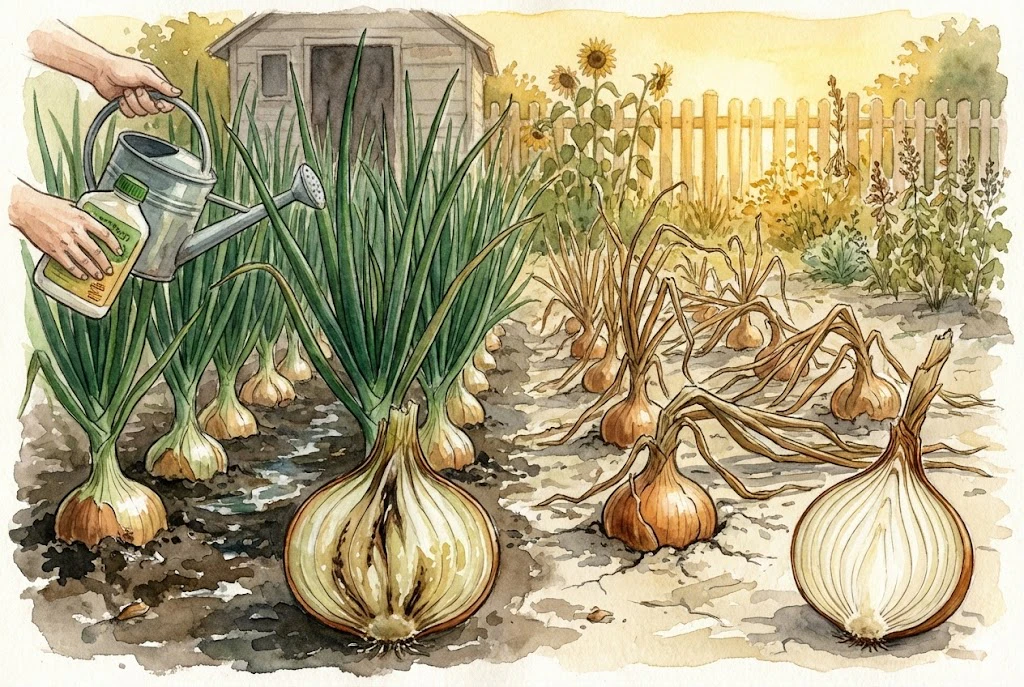
Executive Summary
Summary:
- Onions are photoperiodic plants that require a strict cessation of nitrogen fertilizer at the onset of bulbing to prevent rot and ensure long-term storage.
- Applying fertilizer late in the season disrupts the plant’s natural dormancy cycle, causing ‘thick necks’ that serve as entry points for bacterial and fungal diseases.
- Success lies in front-loading nutrients during the early vegetative stage and managing sulfur levels to control flavor intensity and storage capability.
Key Takeaways:
- The Cut-Off Rule: Stop nitrogen completely when the soil cracks or the bulb diameter exceeds the stem diameter to prevent ‘thick neck’ issues.
- Photoperiod Matters: Match onion varieties (Short, Intermediate, Long Day) to your specific latitude to ensure bulbing occurs at the correct time.
- Sulfur & Flavor: Low sulfur creates sweet onions; high sulfur creates pungent, storable onions.
- Storage Safety: Cure onions until necks are tight and dry, and never store them near moisture-releasing potatoes.
Introduction: The Heartbreak of the Squishy Bulb
you’re likely killing your onions with kindness. If your harvest turns to mush by winter, the culprit is usually late-season fertilizer, not bad luck.
Onions have a biological ‘self-destruct’ switch if fed at the wrong time. I’m going to cut through the marketing fluff and explain exactly how to manage nitrogen and harvest timing so you get rock-hard bulbs that actually keep.
Part I: Onion Fertilizer Timing and the Internal Clock
To understand why your onion fertilizer timing is wrong, you first have to understand that an onion is not trying to feed you. It is trying to survive. An onion bulb is essentially a battery.
The plant spends the first half of its life building solar panels (leaves) to charge that battery. Once the battery is full, the plant shuts down the factory (the leaves) and seals the battery (the bulb) to survive the winter and flower the next year.
This process is governed by an internal clock that is more precise than a Swiss watch. If you ignore this clock, you fight nature, and nature always wins.

The Photoperiod Trigger: It’s Not About the Heat
Many people think onions bulb up because it gets hot. That’s a myth. Onions bulb up because the days get long. They are photoperiodic. Recent physiological reviews confirm that the transition from ‘leaf factory’ to ‘bulb storage’ is triggered by the duration of darkness (or conversely, light).
The onion plant is incredibly sensitive to the light spectrum. It measures the ratio of red to far-red light to determine competition and season.
But primarily, it tracks the duration of daylight. This is why you see onions classified as Short-Day, Intermediate-Day, and Long-Day. This isn’t a suggestion; it’s a hormonal mandate.
When a Short-Day onion receives 10 to 12 hours of daylight, a signal is sent from the leaves to the root system. This signal stops the production of new leaf blades and initiates the swelling of the leaf sheaths—the layers that will eventually become the rings of your onion.
If you plant this variety in the North during late spring, where days are already 14 or 15 hours long, the plant hits the panic button immediately. It bulbs up while it is still a tiny seedling. You don’t get a slicer; you get a pearl onion.
Conversely, if you plant a Long-Day onion in the South, it may never see the 14 to 16 hours of daylight required to trigger that switch. It will grow leaves indefinitely, creating a massive, scallion-like plant that never forms a bulb.
The Insight: Why does this matter for onion fertilizer?
Because the moment that photoperiod switch flips, the plant’s relationship with Nitrogen changes completely. Before the switch, Nitrogen is fuel for the factory (leaves). After the switch, Nitrogen becomes a contaminant in the battery.
The plant shifts its physiological priority from source development (making leaves) to sink filling (storing sugars). If you continue to apply Nitrogen, you are essentially telling the plant to keep building the factory when it is trying to shut down operations.

The Leaf-to-Ring Correlation
Here is a piece of botany that blows minds: Every ring in an onion bulb corresponds to a leaf on the plant.
Count the rings in a sliced onion. Now imagine the plant. If you had 13 leaves on the plant when the bulbing switch flipped, you get 13 rings. If you only had 4 leaves, you get a tiny, 4-ring bulb.
This establishes the ‘Golden Window’ of opportunity. You have a limited time—from planting until the day length hits that critical number—to grow as many leaves as possible.
This is the only time you should be pushing vegetative growth. Once the daylight hours hit the trigger, the door closes. No amount of onion fertilizer can force the plant to make more leaves/rings once the hormonal signal for bulbing has been sent.
If you apply high-nitrogen onion fertilizer after this switch, you aren’t creating new rings. You are forcing the existing rings to hydrate and swell with water and salts, rather than curing down. You are confusing the plant. You are creating a biological conflict where the hormonal signal says ‘stop,’ but the chemical signal (Nitrogen) says ‘go.’

The Juvenile Phase
There is a caveat to the photoperiod rules, known as the ‘juvenile phase.’ An onion plant must reach a certain size—typically around 4 to 5 true leaves—before it is even capable of perceiving the day-length signal. This is a safety mechanism.
If a tiny seedling emerged and immediately sensed long days, it would try to bulb with insufficient energy reserves and die. This juvenile phase protects the plant, ensuring it establishes a root system before committing to reproduction (bulbing).
However, this also means that if you plant too late, or if your fertility program is weak in the first few weeks, the plant might pass through the juvenile phase only to find itself already in the middle of long days.
It will bulb immediately and prematurely. This highlights the absolute necessity of early fertility. You cannot ‘catch up’ later. The game is won or lost in the first 45 days.
Part II: Nitrogen – The Gas Pedal of Onion Fertilizer
Nitrogen (N) is the most misunderstood nutrient in the onion patch. It is the gas pedal of plant growth.
It drives the production of chlorophyll, the green pigment responsible for photosynthesis. It is the backbone of amino acids, the building blocks of proteins. It makes things green, leafy, and vigorous.
In the last few years, researchers have been conducting extensive field trials to pinpoint exactly when Nitrogen stops helping and starts hurting. The consensus is clear: Nitrogen is a double-edged sword.

The ‘Vegetative Phase’ Necessity
In the early stages (the first 30–60 days), onions are hungry. They have shallow, inefficient root systems that look like bad toupees. They lack the root hairs that other crops, like corn or tomatoes, use to scavenge nutrients.
This morphological disadvantage makes them terrible at scavenging nutrients from the soil. They need their food spoon-fed, right in the root zone.
During this vegetative phase, research shows that adequate Nitrogen is non-negotiable. A study on Nitrogen timing demonstrated that applying N at transplanting and during the vegetative stage is critical for maximizing yield.
If you starve them here, you get few leaves. Few leaves mean few rings. Few rings mean small bulbs. The correlation is linear and unforgiving.
The Scientific Sweet Spot:
- Rate: Studies suggest an optimal rate of around 82 kg to 135 kg of N per hectare, depending on soil type and residual nitrogen levels.
- Timing: The research is emphatic—the bulk of this must be available before bulbing starts.
This early application drives the cytokinins—hormones that stimulate cell division. This is exactly what you want in April or May (depending on your zone). You want the plant to explode with green growth. You want it to be robust, with a thick neck diameter at the base, because that neck diameter correlates to the final bulb size.

The Mechanism of Action: Cytokinins vs. ABA
When you feed an onion Nitrogen, you are essentially manipulating its hormonal balance. Nitrogen stimulates the production of cytokinins. These hormones are the ‘fountain of youth’ for plant cells; they delay senescence (aging) and promote cell division.
However, remember the switch? Once bulbing starts, we don’t want new leaves. We want the existing leaves to act as a source, transferring their accumulated sugars (photosynthates) down into the bulb (the sink) and then dying gracefully. This process requires a shift in hormonal dominance from cytokinins to Abscisic Acid (ABA).
ABA is often called the ‘stress hormone,’ but in the context of onions, think of it as the ‘maturity hormone.’ It signals the plant to close the stomata, stop vegetative growth, and induce dormancy.
Key Insight
Think of Nitrogen as caffeine and Abscisic Acid as melatonin. If you keep giving the plant caffeine (Nitrogen) at 10 PM, it can’t sleep (cure). And an onion that doesn’t sleep rots.
If you apply Nitrogen late in the season, you keep cytokinin levels artificially high. The plant ‘thinks’ it is still spring. It refuses to dry down. The cells in the neck remain active and turgid, preventing the formation of the protective seal that is necessary for long-term storage.

The Nitrogen Use Efficiency (NUE) Problem
One of the fascinating aspects of recent research is the focus on Nitrogen Use Efficiency (NUE). Onions are notoriously inefficient. They may only utilize 30-40% of the onion fertilizer applied to the field. The rest leaches into the groundwater or volatilizes into the atmosphere.
This inefficiency drives farmers—and gardeners—to over-apply. ‘If the plant is only eating half,’ the logic goes, ‘I should serve double.’ But this is a trap. The unabsorbed Nitrogen sits in the soil. If a late rain comes, that Nitrogen becomes available to the plant right at the moment it should be starving.
Researchers in Ethiopia and China have found that you can maintain yields with significantly lower Nitrogen rates if the timing is precise. By front-loading the Nitrogen and cutting it off early, the plant utilizes what it needs for leaf production without having excess ‘luxury consumption’ later in the season.
Luxury consumption is when a plant takes up nutrients it doesn’t need for growth, simply because they are there. In leafy greens, this is fine. In storage onions, it is disastrous.
Part III: The ‘Thick Neck’ Pathology – A Self-Inflicted Wound

If you take one thing away from this report, let it be the term ‘Thick Neck.’ In the world of commercial onion farming, this is a dirty word. It represents a crop that is unmarketable, unstoreable, and essentially worthless.
What is a Thick Neck?
A ‘thick neck’ or ‘bull neck’ occurs when the onion bulb finishes growing, but the leaves above it refuse to dry down and fall over. Instead of a tight, paper-thin seal at the top of the bulb, you have a fleshy, green, open chimney.
Normally, as the bulb matures, the tissue just above the bulb (the pseudostem) weakens. The weight of the leaves causes the top to fall over. This ‘lodging’ is the visual signal that the onion is finishing its life cycle. The neck tissue then dehydrates rapidly, shrinking into a thin, tight seal that protects the bulb from the outside world.
In a thick-necked onion, this collapse never happens. The neck stays rigid and thick. It stays green. It stays wet.
The Cause: The Late Nitrogen Surge
Recent trials have shown a direct linear correlation: the later you apply Nitrogen, the higher the percentage of thick necks.
Why? Because the Nitrogen is forcing the plant to keep the neck tissue vegetative. It remains succulent, full of water and chlorophyll, instead of senescing (aging) into dry paper. The plant is allocating resources to maintain this tissue rather than withdrawing them.
This condition is often exacerbated by sparse plant populations. If onions are spaced too far apart, they have less competition for light and nutrients, and they tend to grow larger, thicker necks. But the primary driver is almost always nutritional timing.
The ‘Green Bridge’ for Disease
Here is where the biology gets scary. The neck of the onion is the primary entry point for the two biggest killers of stored onions: Botrytis (Neck Rot) and Pantoea (Bacterial Center Rot).
The Botrytis Mechanism
The fungus Botrytis allii is sneaky. It often infects the plant in the field but remains latent (asleep). It waits for a moisture source. A thick, juicy, green neck that hasn’t dried down is essentially a water slide for the fungus to travel from the leaves down into the bulb scales.
The fungus moves down the neck tissue and establishes itself in the succulent scales of the bulb. You harvest the onion, it looks fine, and you put it in storage. Two months later, you go to grab an onion and your thumb goes right through it. It has rotted from the inside out. This is ‘Neck Rot,’ and it is almost entirely preventable by proper curing and onion fertilizer management.
The Pantoea Mechanism
Bacterial rots like Pantoea and Burkholderia (Sour Skin) thrive in high Nitrogen environments. Research shows that high N levels increase the susceptibility of the bulb tissue to bacterial infection. These bacteria require moisture to move.
A thick neck that fails to dry down provides a continuous humid environment leading directly into the heart of the bulb. Once inside, the bacteria dissolve the pectin that holds the cell walls together, turning your crisp onion into a bag of slime.
The Takeaway
A thick neck is an open wound that never heals. If you have thick-necked onions, you cannot store them. You must eat them immediately. They are the walking dead of your harvest.
Part IV: The Science of the ‘Cut-Off’

So, when do you stop? This is the million-dollar question. The research indicates a hard stop that contradicts almost every general onion fertilizer label you will find at a big-box store.
The Bulb Initiation Threshold
The moment you see the soil cracking around the base of the plant, or you see the bulb swelling to twice the diameter of the stem, the switch has flipped. This is Bulb Initiation.
The Rule
You must cease all Nitrogen application at or before bulb initiation.
- For Short-Day Onions (South): This might be as early as March.
- For Long-Day Onions (North): This is typically mid-June to early July.
A study published in HortTechnology compared applying the final Nitrogen dose at three stages:
- Bulb Initiation
- Bulb Growth
- Bulb Maturation
The results were stark. Applying N at Bulb Initiation gave the best yields. Applying it at Maturation (late season) increased pungency (made them hotter/less sweet) and increased the risk of rot, without significantly increasing yield.
Insight
There is a point of diminishing returns where more onion fertilizer gives you zero extra size but massive storage liability. The plant has shifted its metabolism. It is no longer building machinery; it is storing fuel. Adding more building materials (Nitrogen) just clogs up the works.
Visual Cues for the Gardener
How do you know when to cut the cord? You cannot rely on the calendar alone, because every season is different. A cool spring delays bulbing; a warm spring might accelerate growth. You must read the plant.
- The Leaf Count: If your variety typically has 13 leaves, and you have 10–12, you are nearing the end.
- The Bulbing Ratio: When the bulb diameter is double the neck diameter. This is the universal sign that the sink (bulb) is now the dominant organ.
- The Soil Crack: As the bulb expands, it pushes the soil away. If you see the earth cracking around the base, the expansion phase is in full swing. Stop feeding.
The Danger of ‘Slow Release’
This is a specific warning for the organic gardener. I love organic fertilizers. Compost, blood meal, feather meal—they are fantastic. But they are slow.
If you apply a slow-release organic onion fertilizer source in June, it requires microbial activity to break it down. If June is dry, the fertilizer sits there. Then, July brings a thunderstorm. The moisture wakes up the microbes, they release the Nitrogen, and suddenly your onions get a massive hit of Nitrogen right when they are supposed to be finishing.
Expert Advice
For onions, timing is more important than ‘organic vs. synthetic.’ If you use organics, apply them way early. Pre-plant is best. If you need a mid-season boost, use something liquid and immediately available (like a fish hydrolysate) so you can control exactly when the plant gets it—and more importantly, when it stops getting it.
Part V: Flavor Chemistry – Sulfur and The Tears

Let’s talk about flavor. Why are some onions sweet as apples (Vidalias, Walla Wallas) and others hot enough to strip paint? It’s not just variety; it’s soil chemistry.
The Pyruvic Acid Connection
The ‘heat’ in an onion comes from compounds called S-alk(en)yl cysteine sulfoxides. When you cut an onion, you rupture the cells. An enzyme called alliinase mixes with these sulfoxides and creates breakdown products, including sulfuric acid and the lachrymatory factor (the gas that makes you cry).
One of the byproducts of this reaction is Pyruvic Acid (pyruvate). Scientists use pyruvate levels as a proxy for pungency. The more pyruvate, the hotter the onion.
- Sweet Onions: Typically have pyruvate levels below 3.5 micromoles per gram of fresh weight.
- Storage Onions: Can have levels well above 5.0 micromoles.
Research confirms a direct link between soil Sulfur levels and Pyruvic Acid content.
- High Sulfur + High Nitrogen = High Pungency.
- Low Sulfur = Low Pungency (Sweeter).
The Paradox of Sulfur
Here is the cynical expert’s dilemma: You need Sulfur for the plant to grow. Sulfur is essential for amino acid synthesis (cysteine and methionine). If you have zero Sulfur, you get yellow, stunted plants. The plant cannot build proteins without it.
However, if you want sweet onions, you must starve them of Sulfur late in the season. This is why Vidalia, Georgia, is famous—their soil is naturally very low in Sulfur. The farmers there have to manage Sulfur with surgical precision: enough to grow the plant, but not enough to make it hot.
The ‘Sweet Onion’ Protocol
If you are growing specific sweet varieties, do not use fertilizers with ‘Sulfate’ in the name (like Ammonium Sulfate) late in the season. The research shows that late Sulfur uptake gets dumped directly into the flavor compounds of the bulb, ramping up the heat.
On the flip side, if you are growing storage onions (the hot, hard keepers), Sulfur is your friend. It enhances the structural integrity and creates those potent antimicrobial compounds that help the bulb fight off rot in the cellar. A pungent onion is a healthy onion—it has its own chemical warfare system against bacteria.
The Water Factor
Water stress also increases pungency. If an onion gets dry, it concentrates the flavor compounds. To grow a truly sweet onion, you need low Sulfur and high water content. This dilutes the sulfur compounds. However, remember the rule about rot?
High water + high Nitrogen = rot.
This is why growing sweet onions is an art form. You are walking a tightrope between ‘sweet and juicy’ and ‘rotten mush.’
Part VI: The New Frontier – Biostimulants

Now, let’s look at the ‘new kids on the block.’ If you walk into a garden center today, you are bombarded with ‘Biostimulants,’ ‘Microbial Inoculants,’ and ‘Seaweed Extracts.’ Are they snake oil? Or is there real science here?
Actually, the recent science suggests they might be the real deal—if used correctly.
The Mycorrhizal Advantage
Onions have terrible roots. They are sparse, unbranched, and lazy. They rely heavily on symbiotic relationships with soil fungi (mycorrhizae) to scavenge Phosphorus.
Recent trials showed that microbial biostimulants (specifically mixtures containing Bacillus velezensis and mycorrhizal fungi) significantly enhanced bulb growth.
- Why? The fungi effectively expand the root surface area by hundreds of times. They scavenge nutrients from the soil micropores that the fat onion roots can’t reach.
- The Benefit: They allow the plant to uptake nutrients more efficiently without you having to dump excessive salt-based onion fertilizer on the soil. This improves the ‘Nitrogen Use Efficiency’ we talked about earlier.
Seaweed and Stress
Seaweed extracts (like Kelpak or Ascophyllum nodosum) are rich in plant hormones, specifically auxins and cytokinins. Research indicates that algae-based biostimulants can help onions survive stress.
In a study on saline irrigation (salty water), onions treated with algal extracts performed significantly better than those without. The biostimulants helped the plants regulate their osmotic pressure and continue growing despite the salt stress.
Expert Opinion
Use them early. Dip your roots in them at planting. Drench the soil when the plants are young. But be cynical about the claims of ‘doubling yield.’ They are stress-relievers, not magic wands.
If you have perfect soil, perfect water, and perfect weather, you might not see a huge difference. But who has perfect weather anymore? In a hot, dry summer, a seaweed extract might be the difference between a harvest and a failure.
Humic Acids
Humic acids are essentially concentrated compost tea. They help chelate nutrients in the soil, making them more available to the plant. For onions, which struggle to uptake nutrients, humic acids can act like a ‘delivery service,’ bringing the N-P-K right to the root door.
Research in Utah included humic acid trials and found positive effects on bulb size, particularly in shifting the harvest toward larger size classes (Jumbo and Colossal).
Part VII: The Master Class Onion Fertilizer Schedule

Enough theory. Here is the protocol. This is how I would grow onions if my livelihood depended on it (and it has). This schedule assumes a standard spring planting for an Intermediate or Long-Day onion. Adjust dates according to your latitude, but follow the stages.
Phase 1: The Pre-Load (Weeks 0–2)
Goal: Root establishment.
Chemistry: High Phosphorus (P), Moderate Nitrogen (N).
Action: Do a soil test. If you are flying blind, use a balanced starter fertilizer banded 2 inches below the seed/transplant.
- Why? Phosphorus doesn’t move in the soil. It stays where you put it. You have to put it where the roots will be. Onions need P early to build the root system that will support the top growth.
- Product: A 10-20-10 or similar ratio. Or bone meal if organic (applied weeks in advance).
Phase 2: The Vegetative Sprint (Weeks 3–8)
Goal: Maximum leaf production.
Chemistry: High Nitrogen.
Action: This is the only time you push the gas.
- Frequency: Apply a Nitrate-based fertilizer (like Calcium Nitrate) every 2–3 weeks.
- The Trap: Do not use Urea if the soil is cold; the bacteria aren’t awake to process it. Nitrate is immediately available.
- Biostimulant: Add a humic acid or seaweed drench here to aid uptake.
- Dose: You are aiming for about 20-30 units of Nitrogen per acre per application. For a home garden, this is roughly 1 cup of Ammonium Sulfate (21-0-0) per 20 feet of row.
Phase 3: The Hard Stop (Bulb Initiation)
Goal: Trigger the switch.
Chemistry: Zero Nitrogen.
Action: The moment you see the bulbs swelling (penciling width x 2) or the soil cracking, STOP.
- Walk away from the Nitrogen bag.
- If you must feed, use Potassium (K). Potassium helps regulate water pressure in the cells and thickens the cell walls, which improves storage quality.
- Visual Check: Count your leaves. If you have 10+ leaves, you have done your job. Let them ride.
Phase 4: The Dry Down (Maturation)
Goal: Senescence and Curing.
Action: Cut water.
- When the tops start to droop (lodging), the plant doesn’t need rain. It needs drought.
- Watering now acts just like Nitrogen—it keeps the neck green and invites rot.
- Disease Control: If you are in a wet climate, this is the time to watch for neck rot. If you see it, harvest early and cure artificially. Do not leave them in the mud.
Part VIII: Storage – The Final Exam
You’ve grown them. Now, don’t ruin them in the last week.
The Curing Chemistry
Curing isn’t just ‘drying.’ It is a physiological process where the outer scales lose moisture and form a hermetic seal. The neck tissue must collapse and dry completely.
- Abscisic Acid (ABA): As the bulb dries, ABA levels drop to a minimum, marking the start of dormancy. If you cure at high temperatures (28°C+), you speed this up.
- The Neck Seal: This is critical. You want the neck to be paper-thin and tight. If you can slide your finger into the neck, it’s not cured. It’s a ticking time bomb.
The Curing Environment
Ideal curing happens at warm temperatures (75-85°F) with good airflow and low humidity. If you live in a humid place, do not cure onions in the field.
Bring them into a shed, a garage, or a porch. Put a fan on them. The movement of air is more important than heat. You need to strip that moisture away from the neck as fast as possible to close the door on Botrytis.
The Storage Myth
Don’t store onions with potatoes. I know your grandmother had a root cellar where everything went together, but science says no. Potatoes release moisture and ethylene gas.
Ethylene is a ripening hormone. It triggers the onions to sprout. Onions need cool, dry, air movement. Potatoes need cool, humid, dark. They are bad roommates.
Store your onions in mesh bags or crates. Never in plastic. They need to breathe. The ideal temperature is 32-40°F (0-4°C). If you can keep them this cold, the respiration rate drops to near zero, and the fungi go dormant.
Practical Grower’s Guide: Troubleshooting Your Onions
Problem: ‘My onions are small.’
- Diagnosis: You didn’t grow enough leaves before the photoperiod switch.
- Cause: Late planting, poor early fertility (low N in weeks 1-4), or wrong variety (Short Day planted in North).
- Fix: Plant earlier. Band phosphorus at planting. Push Nitrogen hard in the first 6 weeks.
Problem: ‘My onions have thick necks and won’t dry.’
- Diagnosis: You loved them too much.
- Cause: Late Nitrogen application (after bulbing started) or excessive late irrigation.
- Fix: Respect the ‘Cut-Off.’ No food after the bulbs swell. Eat these onions first; do not store them.
Problem: ‘My onions rotted from the inside out.’
- Diagnosis: Bacterial Soft Rot or Neck Rot.
- Cause: Bacteria entered through a wet neck during curing.
- Fix: Ensure the neck is paper-dry before cutting the tops. If it rains during harvest, cure them indoors with fans.
Problem: ‘My sweet onions are hot.’
- Diagnosis: Sulfur overload or water stress.
- Cause: Used a high-sulfur fertilizer (Ammonium Sulfate) late in the season, or let the onions get too dry and hot.
- Fix: Use low-sulfur fertilizers for sweet varieties. Keep moisture consistent; heat stress increases pungency.
Conclusion: The Art of Benign Neglect
The hardest thing for a gardener to do is nothing. We are conditioned to nurture. We see a plant and want to water it, feed it, fuss over it.
But the onion is a creature of harsh environments. It evolved to grow fast in the spring rains and then hunker down in the dry summer heat of Central Asia. By feeding it Nitrogen late in the season, we are essentially trying to trick it into believing it is endless spring. We are denying its nature.
The science of onion fertilizer is clear: Late Nitrogen is the enemy of quality.
It creates luscious, green tops that look great on Instagram but hide a rotten heart. It produces ‘thick necks’ that act as bacterial highways. It dilutes the flavor and ruins the storage potential.
So, here is your takeaway: Feed them early. Feed them well. Use the biostimulants if you want to give them an edge. But when the days get long and the bulbs start to swell, show them some tough love. Cut the food. Cut the water. Let them dry, wither, and sleep.
Your onions might look a little scraggly in August. The tops will be brown and fallen. Your neighbor’s onions might still be standing tall and green. But come February, when you are slicing a perfect, rock-hard onion for a stew, and your neighbor is throwing away mushy bags of onion fertilizer-pumped bulbs, you’ll understand.
The secret to growing great onions isn’t knowing when to start. It’s knowing when to stop.

Leave a Reply