
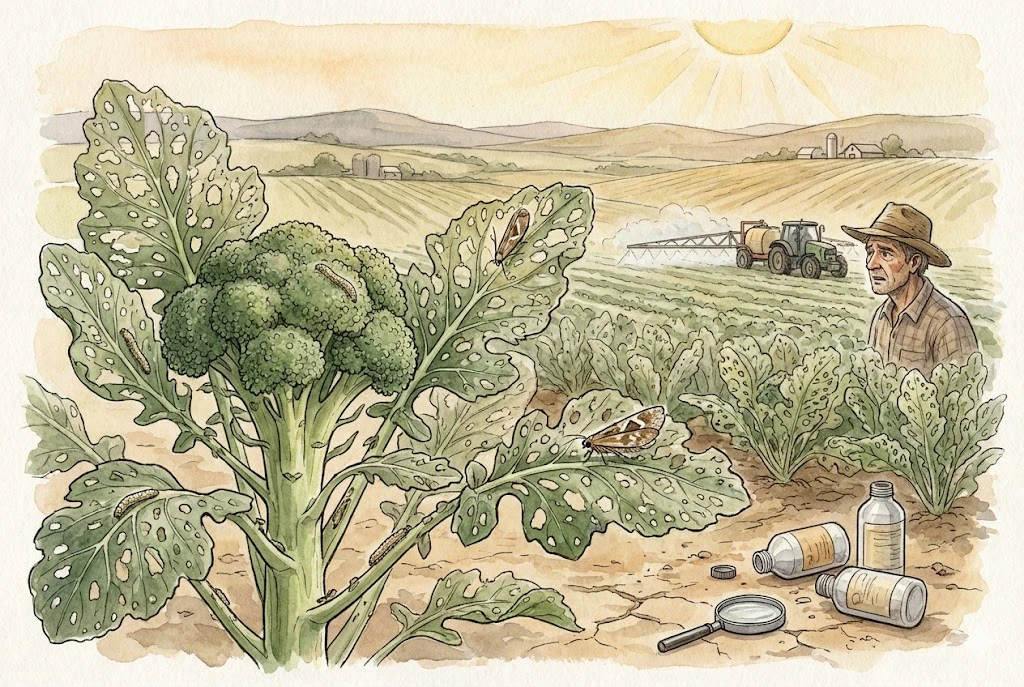
Summary
The 2025 Diamondback Moth (DBM) crisis demands a shift from failing Group 28 chemistries to a strategy integrating Group 31 biologicals and mating disruption.
With DBM resistance reaching critical levels, growers must adopt precise application methods, including pH buffering and underside leaf coverage, to prevent crop failure. This manual outlines a generation-based ‘window’ approach to rotation and highlights the emerging threat of Swede Midge to protect profit margins.
Key Takeaways
- Stop Spraying Pyrethroids: They are ineffective against DBM and kill beneficial predators, worsening infestations.
- Abandon Group 28 Reliance: Widespread resistance to diamides (Coragen, Verimark) means these can no longer be the primary defense.
- Adopt Group 31 Biologicals: New viral options like Lepigen offer a powerful tool against resistance but require strict pH management (5.5–7.0).
- Application Matters: DBM larvae feed on the underside of leaves; success requires high-volume spraying (40–50 GPA) with appropriate surfactants.
- The ‘Blind Head’ Threat: Early detection is vital to prevent DBM and Swede Midge from destroying growing points, which renders the crop commercially worthless.
1. The 2025 Situation Room: Why Your Profit Margin is on the Menu
If you’re standing in a field in Yuma or the Salinas Valley looking at a broccoli crop shredded by the Diamondback Moth (DBM), you know the rules have changed. The ‘easy era’ of spraying Group 28 diamides and walking away is dead. Resistance has hit critical levels just as input costs and regulations are already bleeding margins dry.
This isn’t generic extension advice; it’s a war manual. We are moving past the old playbook to explain exactly why your tank mix is failing and how to rebuild your strategy from the ground up. We’ll cover the new Group 31 biologicals, mating disruption tech, and the creeping threat of the Swede Midge.
2. Know Your Enemy: The High-Performance Biology of Plutella xylostella
You cannot kill what you do not understand. And make no mistake, the Diamondback Moth is an evolutionary marvel designed to humiliate farmers. It is the Formula 1 racer of the insect world: built for speed, highly adaptable, and incredibly difficult to pin down.

2.1 The Velocity of Destruction
The single most dangerous characteristic of the DBM is its reproductive velocity. In the cool weather of a coastal spring, they might move slow. But give them a hot spell—common in the shoulder seasons of Arizona or Georgia—and they hit the accelerator.
At 77°F (25°C), the DBM can complete an entire generation—from egg to larva to pupa to adult—in just 17 days. In a typical broccoli season, which might last 70 to 90 days, you aren’t fighting one generation of pests. You are fighting four or five.
This rapid cycling creates the ‘overlapping generation’ nightmare. In a single field, you will have:
- Adults laying eggs.
- Eggs hatching.
- Larvae feeding.
- Pupae waiting to emerge.
This is why ‘one-and-done’ sprays fail. You might wipe out every larva in the field on Tuesday, but the eggs hatch on Wednesday, and the pupae emerge as adults on Thursday.
You are playing whack-a-mole against a creature that reproduces exponentially. A single female can lay hundreds of eggs. If 50 of those survive to be females, and they reproduce in two weeks… do the math. You go from a ‘few moths’ to a ‘crop failure’ in under a month.

2.2 The ‘Windowpane’ Signature
Identification is critical because DBM requires a completely different chemical strategy than its cousins, the Cabbage Looper and the Imported Cabbageworm.
If you are spraying pyrethroids because you think you have Loopers, but you actually have DBM, you are essentially spraying expensive water (more on that later).
The Larval Profile
- Size: Small. Even fully grown, they rarely exceed half an inch (12mm).
- Appearance: Tapered at both ends, like a tiny cigar. They have two prolegs at the rear that stick out in a distinct ‘V’ shape.
- Behavior: This is the tell. Poke a DBM larva, and it goes nuts. It will wriggle violently backward and often drop off the leaf on a silken thread, hanging there like a paratrooper waiting for you to leave.
- Feeding Pattern: They are surface grazers. They eat the green tissue between the leaf veins but leave the clear, waxy cuticle intact. This creates a ‘windowpane’ effect. As the leaves grow, these windows tear open, creating ragged, shot-hole damage.
The Comparison Table: Don’t Confuse the Crew
| Feature | Diamondback Moth (DBM) | Cabbage Looper | Imported Cabbageworm |
|---|---|---|---|
| Scientific Name | Plutella xylostella | Trichoplusia ni | Pieris rapae |
| Size | Small (Max 0.5 inch) | Large (Up to 1.5 inch) | Medium (Up to 1 inch) |
| Movement | Wriggles violently backward; drops on silk line. | ‘Loops’ or inches along like an inchworm. | Sluggish, velvet-like movement. |
| Appearance | Tapered ends; ‘V’ shape rear legs; segmentation distinct. | Green with white stripes; no legs in the middle. | Velvet green with a faint yellow stripe. |
| Damage Type | Window-paning; mining in heads; ‘blind’ plants. | Large, ragged holes; voracious consumption. | Large holes; massive amounts of wet, green frass. |
| Resistance Level | EXTREME (The Superbug) | Moderate | Low |
| Primary Risk | Cosmetic damage + Bud destruction | Foliage reduction | Foliage reduction |

2.3 The ‘Blind Head’ Catastrophe
The most insidious damage DBM causes isn’t the holes in the leaves; it’s the destruction of the future. DBM larvae have a nasty habit of burrowing into the apical meristem—the growing point—of young seedlings.
If a larva chews out the center of a broccoli transplant, that plant goes ‘blind.’ It will not form a central crown. Instead, it turns into a bush of useless side shoots.
You have paid for the seed, the transplanting labor, the water, and the fertilizer, but that plant will yield exactly $0.00. In severe infestations, field blindness can hit 80-90% if the nursery stock was infested. This is why early detection isn’t just ‘good practice’—it’s financial self-defense.
3. The Resistance Crisis: Why the Old Guard Has Fallen
If you are wondering why the spray program that worked perfectly in 2019 is practically useless in 2025, the answer lies in the genetics of the DBM. This insect is the champion of resistance. It was the first crop pest to develop resistance to DDT in 1953. It was the first to develop resistance to Bacillus thuringiensis (Bt) in the field. And now, it has cracked the code of the diamides.

3.1 The Rise and Fall of Group 28 (The Diamides)
For the last decade, Group 28 was our safety blanket. Chlorantraniliprole (Coragen) and Cyantraniliprole (Verimark, Exirel) transformed the industry. They were systemic, they lasted a long time, and they wiped out worms.
So, we did what humans always do: we abused them. We put Verimark in the transplant water. We sprayed Coragen at thinning. We came back with Exirel at heading. We essentially vaccinated the DBM population against the mechanism of action.
The Molecular Breakdown
Diamides work by binding to the Ryanodine Receptor in the insect’s muscles, forcing calcium channels to stay open. The insect loses muscle control, becomes paralyzed, and dies. Research from 2022 to 2025 across Georgia, Florida, and California has documented a terrifying shift in the DBM genome.
- The Old Mutation (G4946E): In 2018, we saw a mutation that made DBM resistant to Coragen, but Exirel still worked okay.
- The New Mutation (I4790K): By 2025, a new mutation has taken over. This one confers cross-resistance to the entire diamide family. If your worms have the I4790K mutation, switching from Coragen to Exirel is chemically futile. You are picking a different key for a lock that has been changed.
Critical
If you spray a Group 28 and it fails, DO NOT follow it with another Group 28. You are just selecting for the super-resistant survivors.

3.2 The Pyrethroid Graveyard (Group 3A)
Let’s be incredibly direct here: Stop spraying pyrethroids for Diamondback Moth.
Pyrethroids (Mustang Max, Warrior, Bifenthrin, Asana) are functionally useless against DBM in most commercial production areas. Resistance ratios are often 500 to 800 times higher than susceptible populations.
When you spray a pyrethroid on a DBM-infested field, you are actually making the problem worse.
- You don’t kill the DBM: They shake it off.
- You DO kill the beneficials: The lacewings, the Diadegma wasps, and the predatory beetles that were eating the DBM eggs die instantly.
- Result: You have removed the DBM’s natural predators while leaving the pest unharmed. This is called ‘flaring’ a pest, and it is a rookie mistake.

3.3 The Current State of the Arsenal
So, what is left? The toolbox is damaged, but not empty.
- Spinetoram (Radiant – Group 5): This is still one of our heavy hitters, but the clock is ticking. We are seeing creeping resistance in high-pressure areas like Florida and Georgia. It must be protected. If you spray Radiant more than twice a season, you are part of the problem.
- Emamectin Benzoate (Proclaim – Group 6): Still generally effective, but resistance is documented globally. It’s a solid rotational partner, but not a standalone savior.
- Indoxacarb (Avaunt – Group 22A): A voltage-dependent sodium channel blocker. It’s older, but because we stopped using it in favor of Coragen, some susceptibility has returned in certain populations. It’s a good ‘change-up’ pitch.
4. The 2025 Biological Revolution: It’s Not ‘Snake Oil’ Anymore
For years, ‘biologicals’ were the things organic growers sprayed while conventional growers winked at each other. That has changed. In 2025, biologicals aren’t just for hippies; they are the heavy artillery for resistance management.

4.1 The Nuclear Option: Lepigen (Group 31 – Baculovirus)
The biggest news in 2025 is the registration and widespread adoption of Group 31 chemistries: the Baculoviruses. Specifically, the product Lepigen (Autographa californica Multiple Nucleopolyhedrovirus).
This is a targeted biological weapon. It is a virus that specifically infects lepidopteran larvae. Mechanism of Action:
- Ingestion: The larva eats the foliage treated with the virus (it is not a contact killer; they must eat it).
- Dissolution: The virus enters the midgut. The high pH of the insect gut dissolves the protective protein coat, releasing the virus particles.
- Infection: The virus invades the gut cells and replicates. It hijacks the insect’s machinery to make billions of copies of itself.
- Liquefaction: The larva stops feeding, becomes lethargic, turns a dark brown, and literally melts from the inside out.
- The Secondary Cycle: This is the cool part. When the larva dies and ruptures, it releases billions of new viral occlusion bodies onto the leaf. Other larvae crawl over this ‘virus soup,’ eat it, and the cycle starts again. A single spray can initiate a continuous wave of death in the field.
The Rules of Engagement for Lepigen
- Target: Small larvae (1st and 2nd instar). It is less effective on big, hardened 4th instar worms. You use this early in the window.
- pH Sensitivity: This is the Achilles’ heel. The virus is a protein. If you throw it in a tank with alkaline water (pH 8.0+), you denature the protein. You kill the virus before it leaves the nozzle. You must buffer your water to pH 5.5–7.0.
- UV Sensitivity: Viruses degrade in sunlight. Spray in the late afternoon or evening to give the larvae a night of feeding before the sun hits the virus.

4.2 The Old Reliable: Bt (Group 11)
Bacillus thuringiensis is still a cornerstone. But in 2025, we are smarter about strains.
- Bt Kurstaki (Dipel): The standard. Good, but some DBM populations tolerate it.
- Bt Aizawai (XenTari): This strain has a different toxin profile. It is often effective against DBM that laughs at Kurstaki.
- Synergy: 2025 research from the University of Arizona indicates that tank-mixing Bt (XenTari) with a knockdown partner (like Pyganic for organic or a low-rate conventional) can significantly improve mortality compared to either alone.
5. The Emerging Threat: Swede Midge (The ‘Blind Head’ Phantom)
While everyone is watching the Diamondback Moth, another threat is sneaking into American brassica fields: the Swede Midge (Contarinia nasturtii).
Originally a nightmare for Canadian growers, it has been steadily moving south into the U.S. Northeast (NY, VT, PA) and is now being flagged in the Midwest (MN).
5.1 Why You Should Scared
The Swede Midge is insidious because you rarely see the fly. It is tiny (2mm) and weak. But its larvae do devastating damage that mimics other problems.
- The Damage: The larvae feed on the growing tip. They secrete enzymes that break down the plant tissue, causing it to twist, crinkle, and scar.
- The Symptom: If they hit the meristem early, the plant goes blind. No head. Just a scarred stump. Farmers often blame this on ‘heat stress,’ ‘herbicide drift,’ or ‘bad seed.’ In reality, it was a midge infestation three weeks ago.
5.2 Management Complexity
Swede Midge complicates DBM management because it requires different timing. DBM is a foliage feeder; Swede Midge is a heart feeder.
- Rotation: Swede Midge overwinters in the soil. If you plant broccoli in a field that had broccoli (or canola/mustard weeds) last year, you are doomed. You need a 3-year rotation minimum.
- Exclusion: For smaller growers, insect netting (exclusion) is the only 100% effective method.
- Chemicals: The systemic movement of Group 28s (when they work) is helpful here because the larvae are hidden deep in the crinkled tissue where contact sprays can’t reach.
6. The Physics of Spraying: Getting the Poison to the Pest

You can buy the most expensive chemistry in the world—Lepigen, Radiant, Torac—but if you apply it poorly, you are just making expensive compost.
6.1 The Underside Challenge
DBM larvae are agoraphobic. They hate the sun. They spend 90% of their time on the underside of the leaf. Most boom sprayers are designed to drop gravity-fed droplets on the top of the leaf.
If you spray 20 gallons per acre (GPA) at 40 PSI with flat fan nozzles, you are painting the top of the porch while the termites eat the foundation.
The 2025 Application Standard
- Volume: Minimum 40–50 GPA for ground rigs. You need enough water to create turbulence and wrap around the leaf.
- Nozzles: Hollow cone or twin-fan nozzles. You need droplets that swirl, not droplets that plummet.
- Adjuvants: This is non-negotiable. Broccoli leaves are waxy (hydrophobic). Water beads up and rolls off. You need a surfactant.
- Non-ionic Surfactants (NIS): Good general purpose.
- Organosilicones: These are ‘super-spreaders.’ They drop surface tension so low the water crawls into the stomata. Warning: In hot weather, these can cause phytotoxicity (burn), and if you spray to runoff, you lose the product on the ground.
6.2 Water Quality: The Invisible Neutralizer
We mentioned this with Lepigen, but it applies to many chemistries.
- pH: Most insecticides degrade in alkaline water (alkaline hydrolysis). If your well water is pH 8.2, you might lose 50% of your active ingredient’s potency in the tank within a few hours.
- Hardness: Hard water (calcium/magnesium) binds with certain herbicides and insecticides, locking them up.
- The Fix: Buy a cheap pH meter. If your pH is high, add a buffer/acidifier to the tank first, before you add the chemical. Aim for pH 6.0.
7. The New Economics: Mating Disruption and ROI

Farming is a business of margins. With broccoli production costs ranging from $5,700 to $12,000 per acre depending on region and regulatory burden, there is no room for ‘insurance sprays’ that don’t pay off.
7.1 The Case for Mating Disruption
Mating disruption (e.g., CheckMate DBM-F) is a technology that saturates the field with female sex pheromones. The male moths fly around in a cloud of perfume, unable to locate the real females. No mating = no eggs = no larvae.
The Math
- Cost of Mating Disruption: Approximately $45–$50 per acre for the product, plus application. Total ~$90/acre for two applications.
- Cost of Conventional Spray: A tank mix of a premium insecticide (e.g., Exirel or Radiant) + surfactant + application cost can easily hit $100–$130 per acre per pass.
- The ROI: If mating disruption allows you to skip just one insecticide spray, you have broken even. If it saves you two sprays, you are profiting. More importantly, you are preserving the efficacy of the chemicals for when you really need them.
- Scale Matters: Mating disruption works best on larger blocks (10+ acres). On small, isolated patches, mated females can fly in from neighbors.
7.2 The Cost of Failure
Consider the alternative. A field with 10% ‘blind’ plants from early DBM/Swede Midge damage has an automatic 10% revenue reduction.
On a $7,000 gross acre, that’s a $700 loss. Spending $90 on mating disruption or $40 on an early Lepigen spray is cheap insurance against a $700 loss.
8. The 2026 Integrated Strategy: The ‘Window’ Approach

We need to stop thinking about ‘weekly sprays’ and start thinking about ‘generation windows.’ The goal is to expose a single generation of DBM to only one class of chemistry to prevent resistance selection.
Here is a model IPM program for a high-pressure region (e.g., Georgia Fall or Arizona Spring):
Phase 1: Stand Establishment (Days 1–30)
- Goal: Protect the terminal bud. Prevent blind plants.
- Pest Status: Moths migrating in; egg lay beginning.
- Tactic:
- Transplant Drench: If your nursery did not use a Group 28, a Verimark drench is powerful here. However, if the nursery used it, you are banned from using it. Check your slips!
- Alternative: If Group 28 is off the table, start with Lepigen (Group 31). Apply every 5–7 days to target the tiny 1st instar larvae before they burrow.
- Mating Disruption: Apply pheromones immediately after transplanting.
Phase 2: Vegetative Growth (Days 31–60)
- Goal: Protect foliage. Maximize photosynthesis.
- Pest Status: Larval populations building. Overlapping generations.
- Tactic:
- Rotation: Switch MOA. If you used Group 31 early, move to Bt Aizawai (Group 11) tank-mixed with a spreader.
- Thresholds: Scout. If you find >0.3 larvae per plant, bring in the ‘clean up’ hitter: Proclaim (Group 6) or Avaunt (Group 22).
- Avoid: Do not use Radiant yet. Save it for the end.
Phase 3: Heading & Harvest (Days 61–Harvest)
- Goal: Zero contamination. Clean heads.
- Pest Status: High pressure. Large larvae harder to kill.
- Tactic:
- The Closer: Now you use Radiant (Group 5). It has a short Pre-Harvest Interval (PHI) and excellent knockdown.
- Bio-Cleanup: In the final days, Lepigen or Bt can be used again (different generation from Phase 1) because they have 0-day PHI.
- Sanitation: As soon as the knife cuts the head, destroy the crop residue. Don’t leave the ‘Green Bridge’ for the next planting.
9. Regional Intelligence: Tailoring the Plan

9.1 The Desert Southwest (AZ/CA)
- Challenge: Year-round production creates a ‘conveyor belt’ of pests. The ‘bridge’ never breaks.
- Specific Advice: You must communicate with neighbors. If you are spraying Radiant while your neighbor is harvesting, his resistant moths are flying to your field. Area-wide management is key. Watch for the Spring 2025 outbreak predicted due to mild winters.
9.2 The Southeast (GA/FL)
- Challenge: Heat and humidity. DBM generations cycle faster here (14–17 days).
- Specific Advice: Resistance to Diamides is highest here. Assume Coragen/Exirel will fail. Lean heavily on Bt/Lepigen rotations and conserve Radiant. Swede Midge is less of a concern, but keeping an eye on it is wise.
9.3 The North/Midwest (NY/MI/MN)
- Challenge: Swede Midge is the primary ‘new’ threat. DBM migrates in later in the season.
- Specific Advice: Focus on rotation for Swede Midge (soil overwintering). Use exclusion netting for organic or small-scale operations. DBM pressure peaks late (August/September); save your best chemistry for the fall crop.
10. Conclusion: The Definition of Insanity
The definition of insanity is spraying the same tank mix that failed last week and expecting the worms to die this week. In 2025, that is also the definition of bankruptcy.
The Diamondback Moth has changed the game. It has evolved to beat our best tools. But we have evolved too. We have viruses that melt larvae, pheromones that confuse lovers, and bacterial toxins that perforate guts. We have the technology to win this war, but only if we use it with precision.
The Final Checklist:
- Check the Water: Is your pH < 7?
- Check the Larvae: Are they small enough for Lepigen? Are they actually DBM and not Loopers?
- Check the History: Did the nursery use Verimark? If so, put the Exirel jug back on the shelf.
- Check the Coverage: Are you hitting the underside of the leaf?
Farming is hard enough without feeding your profits to a moth. Fight smart. Rotate your modes of action. And for the love of all that is holy, stop spraying pyrethroids.
Appendix: 2026 Technical Reference
Table A: The 2026 Insecticide Rotation Guide for DBM
| Product | Active Ingredient | IRAC Group | Best Use Window | Resistance Status (2025) | Notes |
|---|---|---|---|---|---|
| Lepigen | AcMNPV (Baculovirus) | 31 | Early / Small Larvae | Susceptible | Needs pH < 8. Ingestion only. |
| Radiant | Spinetoram | 5 | Pre-Harvest / Heading | Caution | Save for the end. Max 2 apps/season. |
| Proclaim | Emamectin Benzoate | 6 | Mid-Season | Low/Moderate | Good clean-up tool. |
| XenTari | Bt aizawai | 11A | Rotation Partner | Low | Better than kurstaki on DBM. |
| Dipel | Bt kurstaki | 11A | General Rotation | Moderate | Standard baseline control. |
| Avaunt | Indoxacarb | 22A | Rotation Partner | Moderate | Good voltage-gated channel blocker. |
| Verimark | Cyantraniliprole | 28 | Planting Drench ONLY | HIGH | Do not use if nursery used it. |
| Exirel | Cyantraniliprole | 28 | Foliar | HIGH | RISKY. Cross-resistance with Coragen. |
| Coragen | Chlorantraniliprole | 28 | Foliar | HIGH | Widespread failure in GA/AZ. |
| Mustang/Warrior | Pyrethroids | 3A | NEVER | EXTREME | Kills beneficials. Flares DBM. |
Table B: Degree-Day Development of DBM
Knowing when the next generation hits allows you to time sprays.
| Temperature | Egg to Adult Duration | Implication |
|---|---|---|
| 59°F (15°C) | ~47 Days | Slow growth. Low pressure. |
| 68°F (20°C) | ~25 Days | Moderate pressure. Weekly scouting needed. |
| 77°F (25°C) | ~17 Days | Explosive growth. Overlapping generations. |
| 86°F (30°C) | ~12-14 Days | Critical. Spray intervals must tighten. |
Table C: Surfactant Selection Guide
| Adjuvant Type | Function | Best For | Warning |
|---|---|---|---|
| Non-Ionic (NIS) | Spreading / Wetting | General Insecticides | Safe standard. |
| Organosilicone | Super-spreading / Stomatal entry | Translaminar products | Can cause run-off or burn in heat. |
| MSO / COC | Penetration | Herbicides / Some insecticides | High risk of phytotoxicity on brassicas. |
| Acidifier/Buffer | pH Reduction | Biologicals (Lepigen/Bt) | Essential for alkaline water (>pH 7). |

Leave a Reply