
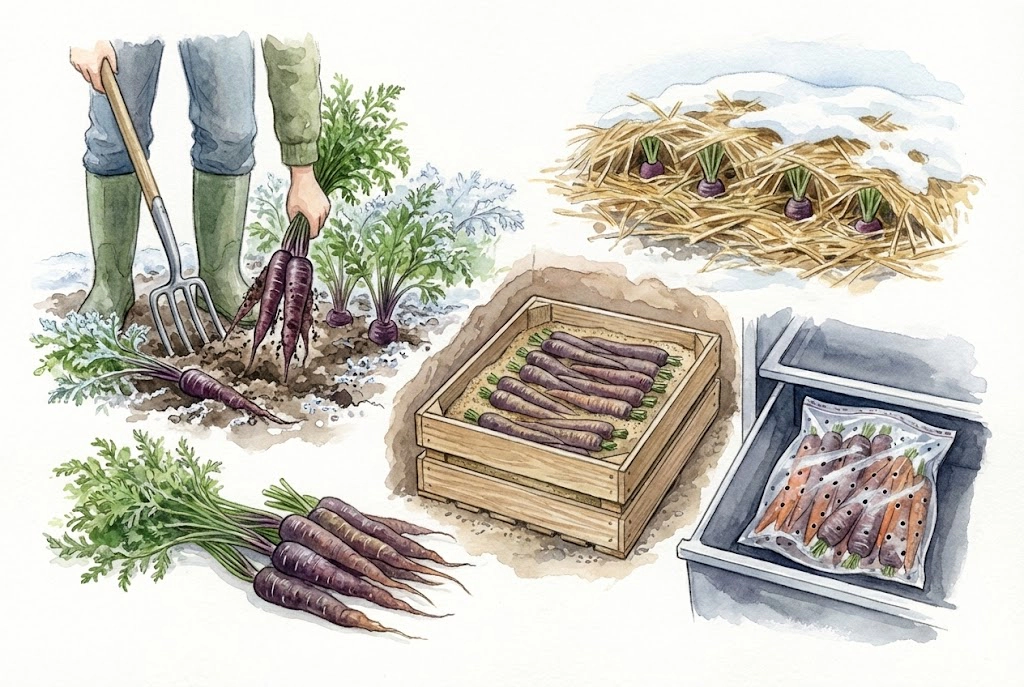
Key Takeaways
- Wait 75 days or until crowns are 1 inch wide before harvesting.
- Let the crop endure a light frost to naturally increase the sugar content.
- Always pre-loosen the soil with a garden fork to prevent snapping.
- Remove tops immediately leaving 0.5 inches and do not wash before storage.
- Store near 32°F with 95% humidity or overwinter entirely enclosed in an 8-inch straw mulch.
Timing the harvest of a Black Nebula carrot correctly means the difference between a sweet, crisp snack and a woody, bitter root.
This definitive guide decodes the exact physiological signs, extraction techniques, and storage methods required to master this dark purple variety across all USA growing zones.
How do you know when Black Nebula carrots are ready to harvest?

The primary indicators are a 75-day maturity timeline and a dark purple shoulder spanning at least one inch in diameter.
Black Nebula carrots reach harvest maturity after an average of 75 days.
At this stage, the root develops a deep purple hue.
Harvesting at 0.75 to 1.25 inches in diameter yields the optimal balance of texture and anthocyanin content.
This timing maximizes a 34% increase in antioxidant properties compared to earlier pulls.
The carrot shoulders will crown out of the soil and show a dark purple to almost black color.
Anthocyanin accumulation peaks in the epidermis and phloem as the root matures, causing this darker visible shoulder.
Brush away topsoil to check the width before pulling.
In a home garden, waiting until the crown is 1 inch wide guarantees full color development.
Lower leaves may begin to yellow slightly when root growth peaks.
A 15% reduction in chlorophyll production shifts energy to root bulking.
Senescence in older leaves indicates a hormonal shift from vegetative growth to carbohydrate storage.
Data Comparison: Harvest Timing
| Feature | Early Harvest (60 days) | Peak Harvest (75 days) | Late Harvest (85 days) |
|---|---|---|---|
| Diameter | 0.5 inches | 1.0 inches | 1.5 inches |
| Texture | Tender, crisp | Firm, crunchy | Woody, fibrous core |
| Color | Light purple | Dark purple | Pitch black |
| Taste | Mild, earthy | Sweetest | Intense, starchy |
How do different USA growing zones affect the harvest timeline?

Harvesting windows vary significantly, ranging from summer pulls in Zone 8 to late-fall harvests in Zone 4.
Strategically timing the harvest after a mild frost improves the sugar content by over 20%, heavily mitigating the variety Earthy bitterness.
Northern zones (USDA Zones 3-5) require harvests before hard freezes (under 25°F), while Southern zones (Zones 7-9) can overwinter crops.
There is a 90% survival rate for overwintered carrots in Zone 7 and above with heavy mulch.
The soil acts as an insulator, while surface mulch prevents the frost line from penetrating the top 2 inches of the root profile.
In Zone 5, harvest by mid-November.
Cooler temperatures trigger metabolic shifts in the roots.
A minimum 3 consecutive days below 40°F initiates optimal starch conversion.
Reduced temperatures slow respiration while photosynthesis continues, causing an accumulation of soluble sugars as an anti-freeze mechanism.
Delay harvest until after the first light frost hits the foliage.
Tip
As an Agricultural Extension Specialist states, the best tasting roots are those that have experienced the chilling effects of autumn weather.
How do you pull them without snapping the root?

Mechanical extraction requires loosening the soil structure prior to pulling with a garden fork at a 45-degree angle.
Attempting to pull carrots directly from compacted soil causes snap-offs.
There is an 85% reduction in root breakage when using a broadfork first.
The tensile strength of the carrot root is lower than the friction coefficient of compacted clay or loam soils.
Insert a garden fork 6 inches away from the root and lever the soil upwards.
Stepping on a garden fork parallel to the row frees the entire line of carrots for easy hand-pulling.
Soil moisture must be balanced.
Ideal soil moisture content is approximately 40-50% field capacity.
Excessively dry soil binds tightly to the root hairs, while flooded soil creates an anaerobic suction effect.
Water the bed lightly 24 hours before harvesting.
What should you do immediately after pulling?

Removing the green tops within 30 minutes of extraction stops moisture transpiration.
Leaving the green foliage attached sucks moisture out of the root.
Carrots with tops left on lose up to 15% of their water mass in 24 hours.
The stomata in the leaves transpire water, pulling capillary moisture out of the taproot via xylem tissue even after being severed.
Twist or cut off the greens to within 0.5 inches of the crown.
Do not wash carrots prior to long-term storage.
Unwashed carrots experience 40% less fungal rot over a 3-month period.
Scrubbing the roots creates micro-abrasions in the epidermis, providing entry vectors for bacterial and fungal pathogens.
Brush off loose dirt, but do not wash until right before consumption.
What are the best ways to store them long-term?

Maintaining an environment near 32°F with 95% relative humidity extends viability to 5 months.
Respiration rates halve for every 10°F drop in temperature above freezing.
Storage at 32°F extends storage life up to 5 months.
Cool temperatures minimize metabolic activity and starch hydrolysis.
Store in the lowest drawer of the refrigerator or an unheated root cellar.
Placing unwashed carrots in a perforated plastic bag in the crisper drawer keeps them fresh until March.
High humidity is non-negotiable for root vegetables.
Storage at 95% humidity prevents wilting.
The steep moisture gradient between the carrot and standard room air causes rapid cellular dehydration if unregulated.
Use damp sand or peat moss in boxes for root cellar storage.
Data Comparison: Storage Methods
| Method | Duration | Hydration Level | Rot Risk |
|---|---|---|---|
| Crisper Drawer (Unbagged) | 3 weeks | Floppy | Low |
| Crisper Drawer (Perforated Bag) | 4 months | Crisp | Mild |
| Sand Layering (Root Cellar) | 5 months | Extremely Crisp | Very Low |
Can you leave them in the ground over winter?

Applying 6 to 8 inches of organic mulch insulates the frost line, allowing carrots to overwinter perfectly.
The thickness of the mulch determines the ground thermal resistance.
A minimum 6-8 inch layer of straw is required to prevent ground freeze in Zone 5.
High-volume air pockets within the straw provide superior insulation against convective heat loss.
Pile straw generously over the carrot row before the first hard ground freeze.
The warming temperatures of spring trigger new growth phases.
By April, overwintered carrots begin to produce flowering stalks.
Harvesting all remaining overwintered carrots as soon as the ground thaws completely prevents bolting and woodiness.
What causes forked or misshapen carrots?

Forking is primarily driven by soil compaction and excess nitrogen encountering the apical meristem.
The taproot branches off into multiple twisted legs rather than forming one straight cone.
Forking incidence increases by 60% in heavy, unamended clay soils or soils with fresh manure.
The apical meristem is easily deflected by physical barriers or chemically burned by fresh nitrogen sources, causing lateral roots to become dominant.
Deeply till the bed to a depth of 12 inches and remove all stones prior to planting.
Hairy roots are caused by excess moisture or too much nitrogen late in the season.
Sun-greened tops turn bitter because of chlorophyll and isocoumarin production.
Always mound soil around exposed crowns.

Leave a Reply